An Initial Public Offering (IPO) is the most significant change to a company when it transitions from private to public ownership. This is the first time a company sells part of its equity shares to the public through a stock exchange. Therefore, apart from raising funds for the company, it also offers an investment avenue of choice to individuals and institutions. IPOs are considered an important capital-raising mechanism, often viewed as the culmination of a company’s development journey.
Recently, there has been a trend with IPOs in the Indian markets, as companies from a range of sectors are in search of IPO opportunities in public markets to grow and develop into new businesses. In order to examine the significance of IPOs, it is helpful to examine their meaning, process, types, and participants in the market.
Understanding the Meaning and Purpose of IPOs
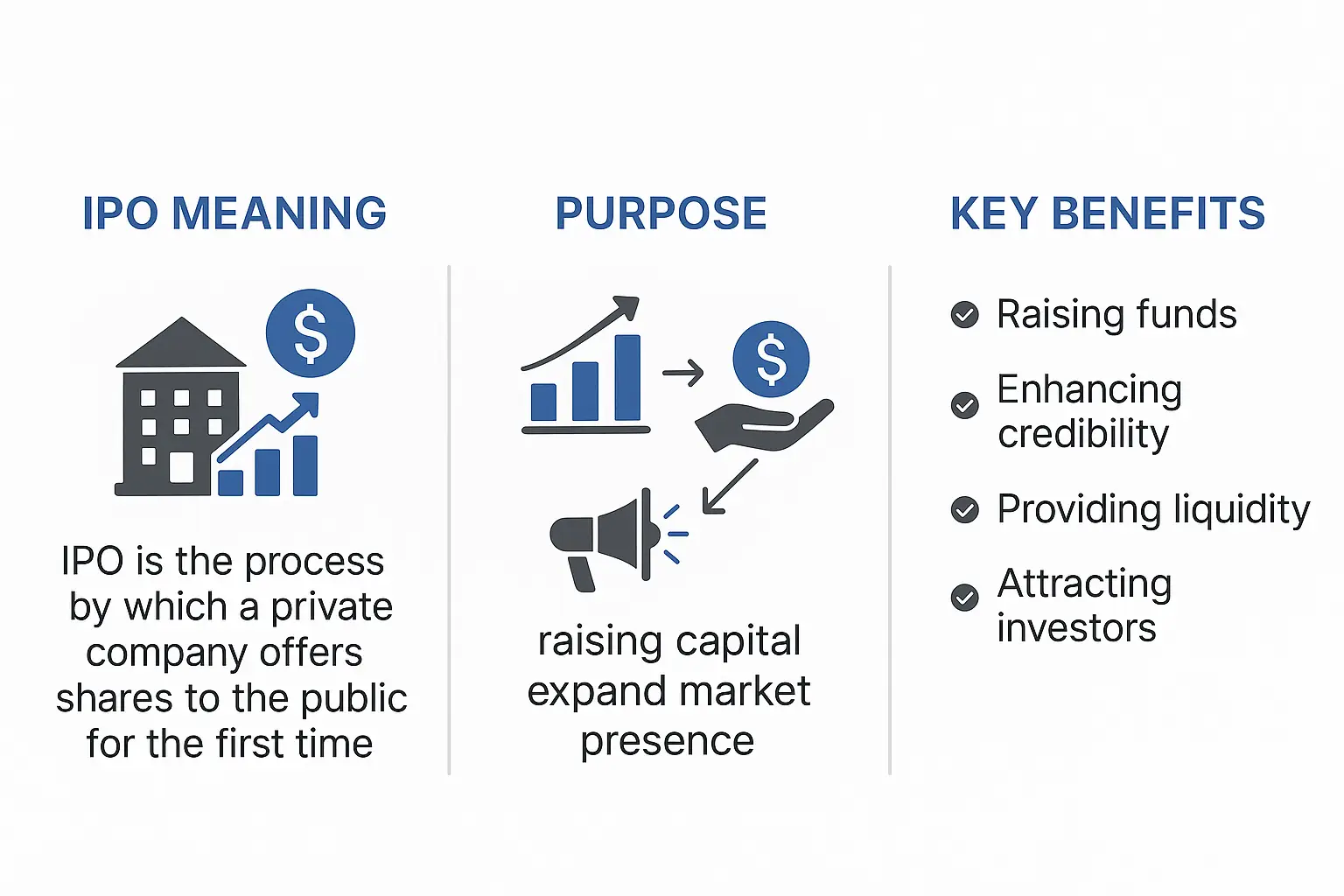
An Initial Public Offering (IPO) is when a private entity sells its shares to the public for the first time. The main goal of an IPO is for cash to be injected into the business for purposes such as growth, development, debt repayment, or perhaps an infrastructure investment. More importantly than finding liquidity, “going public” creates awareness of a company’s value and its brand.
In addition, a successful IPO also allows founders and original investors to realise the value of their investment. Further, shares acquired through an IPO can be a means of currency for future acquisitions or employee options.
Nonetheless, when a company goes public, it becomes subject to restrictions and obligations that would require the additional oversight of publicly traded securities and become subject to much greater scrutiny by the public. They will also need to be subject to much greater transparency and comply with the regulations for each of the necessary oversight bodies.
Types of IPOs: Fixed Price vs. Book Building
There are two main stock offering structures for IPOs:
- Fixed Price IPO: The price at which the shares will be offered to investors is negotiated and set by the company and the underwriters. That price remains unchanged and defined throughout the offering period.
- Book Building IPO: The price is set based on a bidding system, meaning the investors make bids within a defined range of prices. The final offering price is based on the demand from institutional and retail investors.
Book building is more commonly used now because it allows for more price discovery and provides a mechanism for assessing market sentiment.
Equity Shares in an Initial Public Offering (IPO)
The stock that an investor purchases in an IPO is partial ownership of a company. Once an investor purchases equity shares through the IPO, the investor will receive voting privileges, rights to any possible dividends, and to realise capital appreciation.
How many of shares offered and the price of shares will establish the company’s marketability of capitalisation, and the distribution of ownership among all old and new shareholders. After the IPO, shares will be tradable by the investor on an exchange and will be determined by the market, company results and investors’ sentiment.
Lock-in periods for early investors and promoters are commonly used to prevent hoarding a stock option before sale, and to keep prices from destabilising with immediate sale to the sentiment.
Key Stakeholders in the IPO Ecosystem
The success of an IPO relies on a group of contributors:
- Anchor Investors: Institutional investors who subscribe to shares in the IPO before it is made available to the public. Their engagement in the capital market indicates confidence and also tends to support demand for shares.
- Qualified Institutional Buyers (QIBs): Entities such as mutual funds, banks, and foreign institutional investors that get the greater share of the IPO, so that the institutional credibility exists in the market.
- Retail Investors: The individual investor who typically invests relatively small shares in relation to market volume. The retail investor may have a small capital structure, but their participation may represent a larger trusted public capital by the company.
- Regulators: The market body that regulates the market,, such as SEBI in India, puts checks in place to ensure the application is ethical and that the disclosures are easily comprehensible to the investor community.
One notable institutional investor in the Indian IPOs is the Life Insurance Corporation of India, or as it’s commonly called, LIC. Because of the government of India’s backing and enormous financial base, the entry of an LIC into the public listing often signals immediate credibility and invites other large partnerships.
IPO Process: From Private to Public
There are different steps involved in taking a company public.
- Underwriters are appointed: The investment banks look at the company’s value, and they structure the IPO.
- The Red Herring Prospectus (RHP) is drafted: This document contains the business model, financial statements, risks and the objectives of the IPO. It is filed with SEBI.
- Marketing the IPO: Roadshows and investor presentations are done to create interest in the prospective buyers of the IPO.
- Price Band and Bidding Window: In an IPO that employs book-building, a price band is announced. Investors submit their bids in this window.
- Subscription and Allotment: Based on subscription, investor-type allotments are made based on demand and if subscribed and oversubscribed, usually allotted by lottery.
- Listing on the Stock Exchange: Upon allotment, shares are credited to the demat accounts, and then the company is listed and trading can start publicly.
This process follows the requirements of the regulatory environment, ensuring transparency and optimum facilitation for a private company can operate as a public company on the capital markets (shares like a company that is already public).
Offer for Sale vs. Fresh Issue
IPOs may involve:
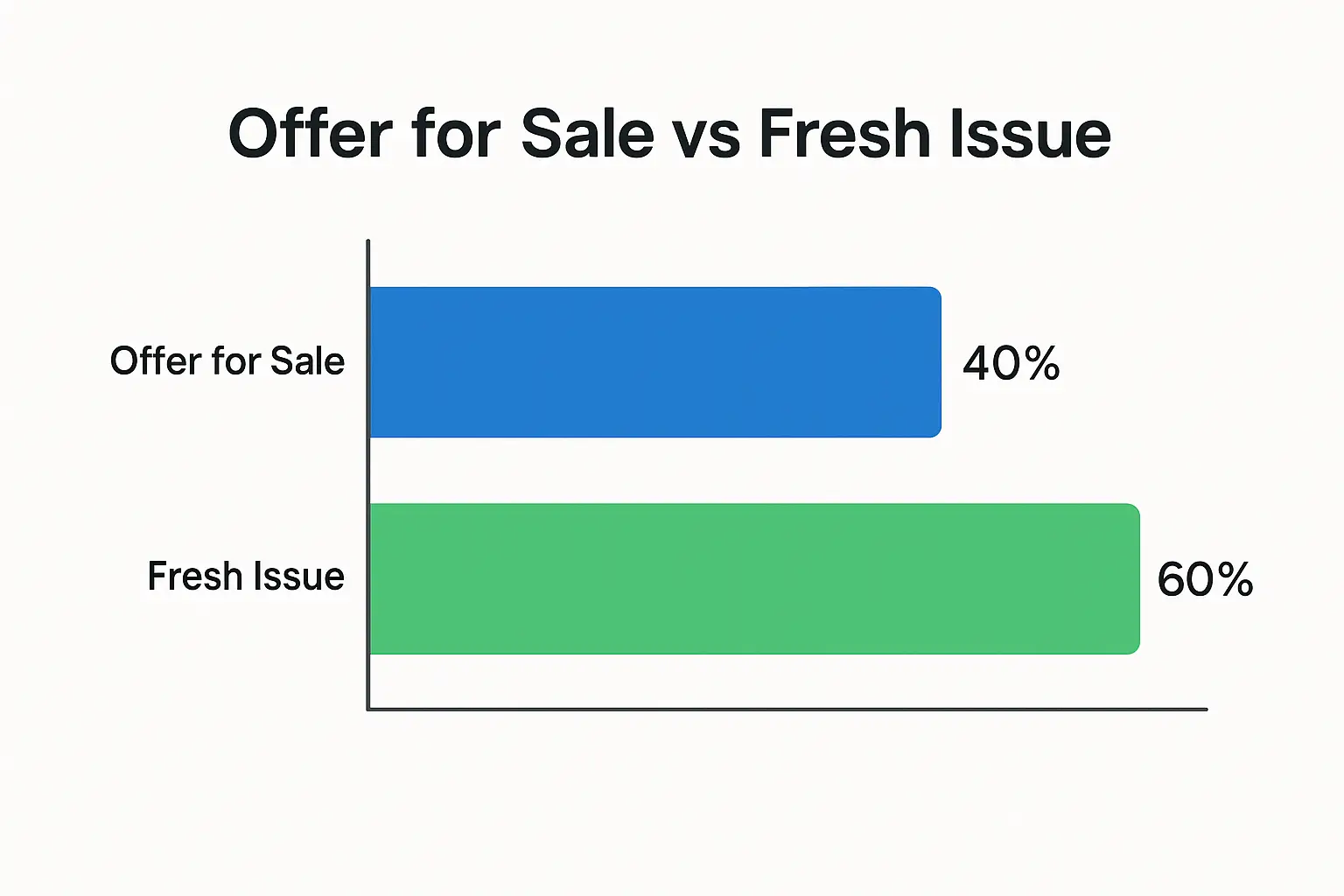
- Offer for Sale (OFS): Existing shareholders sell a portion of their stake. The company itself does not receive any new money from this transaction.
- Fresh Issue: The company sells new shares to the public, which results in raising capital and financing operational needs. It is common to see a combination of both, providing liquidity to early investors and still generating funds for growth.
Recent Trends in Indian IPOs
The Indian IPO landscape is very active as we enter 2025. There has been everything from high-profile companies going public to niche SMEs beginning to be part of the pantheon of IPO companies. The investor’s habits and preferences have evolved, ashaves which sectorsthat are in favor for investment.
One example is Anthem Biosciences, which is a pharma-focused contract research organisation that had a takeoff in issue share price and launched a ₹3,395 crore IPO because of the solid top-line and bottom-line growth as seen previously, and saw international certifications.
SME IPO’s such as Spunweb Nonwoven or Monika Alcobev seem to have made an impact. The sentiment seems to be more inclusive for mid-sized companies. The IPO market seems to be a bit more selective, with the better companies hitting the headline,s but the optimism stems from improvement in financials, sectoral tailwinds and credit growth.
Investor sentiment is cautious and less upbeat than in previous bull runs. The role of anchor investors remains critical for the early perspective of confidence, whereas the institutional players have begun a more analytical perspective when it comes to considering valuations and future growth prospects.
The Importance of Informed IPO Investing
Investing in an IPO isn’t just a form of excitement. Investors are required to review the RHP, check the fundamentals of the company, assess sectoral dynamics, and examine valuation measures. Some IPOs will perform well and offer excellent listing gains, while some will do poorly, particularly if investor expectations do not match the realities of the business.
It is becoming important for retail and institutional investors to utilise tools that deliver enhanced IPO tracking and entry.
Why Platforms Like Tradex.live Make a Difference
Investing in an IPO can be difficult and challenging, particularly for first-time investors. That’s where modern trading platforms come in, with platforms like Tradex.live offering a simple user interface, live IPO tracking, and powerful insights into upcoming and existing offerings.
Tradex.live is built to help new-age investors easily engage in public offerings. Whether you are hoping to subscribe to a popular Initial Public Offering (IPO) or track the performance of a company after it lists, the platform allows investors to find the information required to make informed decisions.
Tradex.live also accommodates zero brokerage trading, margin leverage, and 24×7 withdrawals, giving a hassle-free experience that works for any type of equity investor. Considering IPOs continue to be a starting point for discovering companies with the potential for hyper growth, having a trustworthy platform in today’s market is not just desirable, it’s also necessary!
Final Thoughts
IPO events mean that companies can explore new territory and provide investors with the opportunity to invest in something exciting/. With increased public participation and ongoing changes to regulations, IPOs are a key feature of the equity markets.
However, when investing in IPOs, success depends on staying informed, analytical, and tactical. Solutions like Tradex.live can provide the insight to remain ahead of a fast-paced Initial Public Offering (IPO) landscape. Given the relative experience level of any given retail investor, with the right education and tools at their disposal, shares of IPOs can provide exceptional opportunities for retail investors and experienced traders.
Download app: Android User | IOS User | Web Trader
Reach Tradex.live: https://tradex.live/links/