A stock is the simplest way to own a piece of a real business. You buy one share of Reliance, you own a fraction of Reliance. You buy a share of Apple, you own a fraction of Apple. The company makes money, the share price goes up over time. The company struggles, the share price reflects that too. Centuries of finance, distilled into one idea.
What’s changed is the access. A trader in Kolkata in 1995 had no realistic way to buy Apple stock. Today, the same trader on Tradex1.live can buy Reliance and Apple in the same session, on the same platform, with the same login. Indian stocks on NSE and BSE, global stocks on NASDAQ, NYSE and London — all live, all in one wallet, all in your hands.
This page covers everything you might need to know about stocks — what they are, how to value them, the different types, how to actually buy them, what Tradex1.live offers specifically, and the practical mistakes to avoid. Skim to the section that matches your stage.
A stock — also called a share or equity — is a unit of ownership in a company. When a company wants to raise capital without taking on debt, it sells small ownership pieces (shares) to investors through a stock exchange. You buy a share, you become a part-owner of that business, however small that fraction may be.
As a shareholder you generally get two kinds of returns:
There’s a third return that people often forget: voting rights. As a shareholder, you get to vote on major company decisions in proportion to your holding. For retail investors this is mostly symbolic — but it’s the legal basis of why owning stock means owning the company.
Why do people buy stocks? Because over long time horizons, equities have historically delivered the highest inflation-adjusted returns of any major asset class. Indian equity markets have averaged around 12–15% annualised returns over multi-decade periods. That’s the long-term case. The short-term case — for traders — is that stocks move every day, and those moves create opportunities.
The two major Indian indices to know are the Nifty 50 (top 50 companies on NSE) and the BSE Sensex (top 30 on BSE). These two indices are how most people quickly check "how is the market doing today."
Indian investors are increasingly going global, and for good reasons. The biggest companies in the world — Apple, Microsoft, NVIDIA, Google, Amazon, Tesla — are listed in the US. Limiting yourself to Indian-only stocks means missing entire sectors (AI, semiconductors, EVs, mega-cap tech) that simply don’t have Indian equivalents at scale.
Tradex1.live gives Indian users access to global stocks through both direct international access and CFD-based exposure to global equities. This means you can:
Under RBI's Liberalised Remittance Scheme (LRS), Indian residents can invest up to USD 250,000 per financial year abroad, which is more than enough headroom for the vast majority of retail investors. CFD-based global stock access on Tradex1.live gives you exposure without the complexity of opening a US brokerage account.
Indian stocks on NSE and BSE, plus US stocks on NASDAQ and NYSE, plus global equities through CFD access. One login covers what most platforms force you to spread across three accounts.
Thousands of instruments — Indian large-cap, mid-cap and small-cap stocks; US mega-caps; sector-specific stocks across tech, banking, pharma, consumer, energy; ETFs and index trackers. If you want exposure to it, it's probably here.
Live tick-by-tick pricing, depth-of-market data, news integration, and basic fundamental snapshots on each stock. You don't need three subscriptions to make an informed decision.
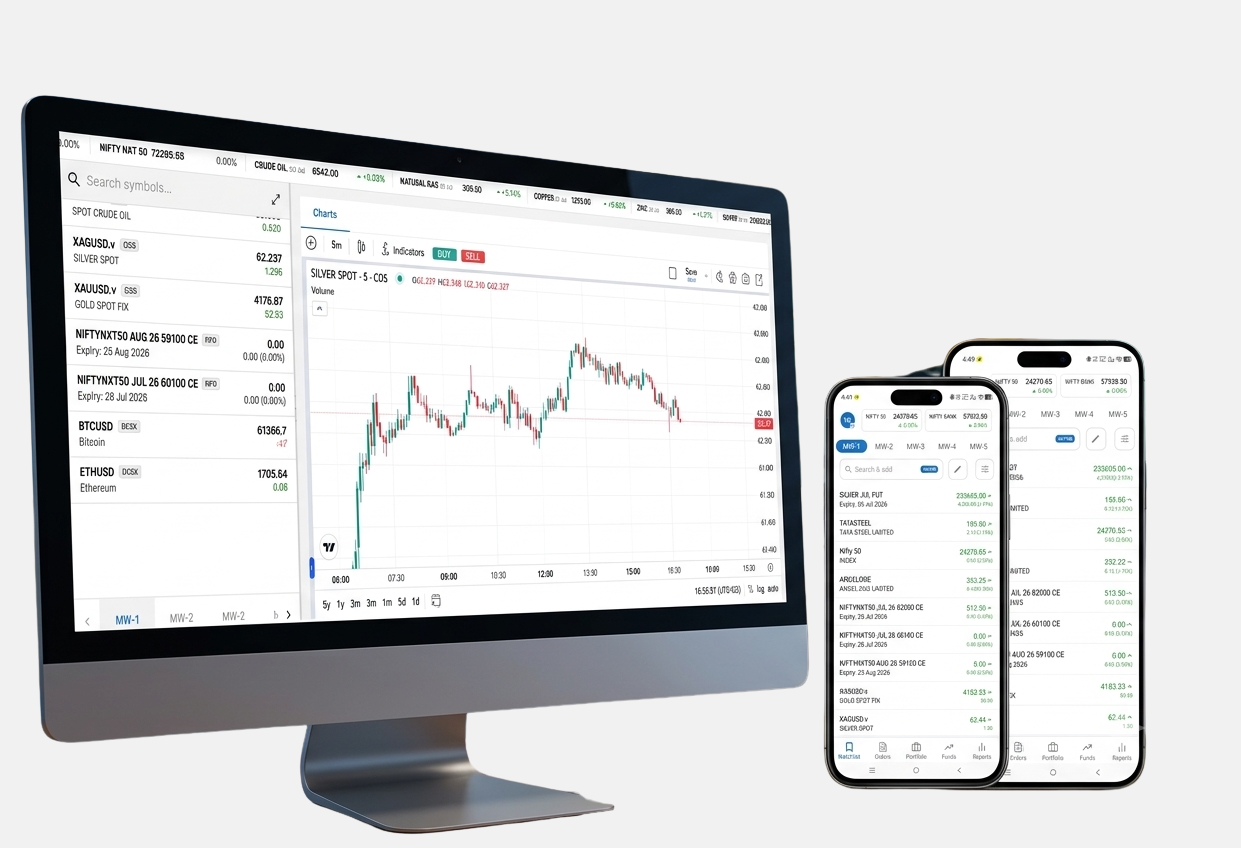
The platform is built for traders who want speed and clarity over visual clutter. Order placement is one or two taps. Charts and order books sit side by side. No five-menu deep navigation to find your watchlist.
When you have a question about a position, margin call, or settlement issue, you reach someone who actually understands markets — not a script-reader. Same support quality whether you're trading ₹5,000 or ₹5 lakh.
Fill in basic details, upload PAN and address proof. eKYC processes most accounts in under 15 minutes.
Deposit via UPI, IMPS, NEFT or netbanking. Money reflects quickly. For US stock access through CFD, the same INR funding works — no separate USD account needed.
Use the platform's search to find any listed company. Check the live chart, recent news, basic financials and trading volume. For Indian stocks, the NSE/BSE pages also give you the full filings history if you want to dig deeper.
Pick "Buy." Enter the quantity. Choose order type — market (executes immediately at the prevailing price) or limit (executes only at the price you set or better). Confirm.
Track unrealised profit and loss in the portfolio section. Set price alerts if you don't want to babysit the screen all day.
Sell whenever you want — same day (intraday), next week, next year. The decision is yours. For long-term holdings, you're typically thinking in years; for trading positions, in days or hours.
Looking at the actual business behind the stock. Key things to check:
Looking at the price chart to determine entry and exit timing. Key concepts:
Most successful investors use fundamentals to decide what to buy and technicals to decide when. Picking either one in isolation is a common mistake.
| Market | Time (IST) | Details |
|---|---|---|
| NSE / BSE Pre-open | 9:00 AM – 9:15 AM | Price discovery only, no live trading |
| NSE / BSE Normal | 9:15 AM – 3:30 PM | Main Indian equity session |
| NYSE / NASDAQ Regular | 8:00 PM – 2:30 AM (next day) | Wall Street hours in IST |
| NYSE / NASDAQ Pre-market | 2:30 PM – 8:00 PM | Light volume but possible to trade |
| LSE (London) | 1:30 PM – 10:00 PM | Major European market |
Cost transparency matters. Here's what you'll actually pay when you trade stocks:
Tax rules can change with Budget announcements. Always confirm current rates with a CA or the official Income Tax site before filing.
A stock is a share of ownership in a company. When you buy one share of Reliance, you own a fractional piece of Reliance. As the company grows in value, your share generally goes up. Many companies also share their profits with shareholders through dividends. That’s the entire concept.
Sign up on a platform like Tradex1.live, complete eKYC with PAN and address proof, fund your account through UPI or netbanking, then search for the stock you want, choose buy, enter quantity, and place a market or limit order. The whole process from sign-up to first trade takes 15–30 minutes.
You can start with as little as ₹500–₹1,000. Most Indian stocks are priced affordably enough for a single share to be within reach. For US stocks, fractional share access on Tradex1.live lets you buy a piece of expensive stocks like Berkshire Hathaway or Booking.com for a few hundred rupees. There’s no minimum balance requirement.
Most experienced investors recommend starting with large-cap, well-established companies — Reliance, HDFC Bank, TCS, Infosys, ITC in India. They’re less volatile, more transparent, and easier to research. Avoid penny stocks and small-caps until you’ve built some experience. ETFs tracking Nifty 50 or Sensex are another solid starting point.
Yes. Tradex1.live gives Indian users access to US stocks (NASDAQ, NYSE) through both direct and CFD-based access. You can trade Apple, Microsoft, NVIDIA, Tesla, Google and hundreds more without opening a separate US brokerage account. Funding works in INR and conversion happens automatically.
Practically, they mean the same thing — both refer to ownership in a company. “Equity” is the broader financial term covering all forms of ownership; “stock” is the specific tradeable unit. When someone says “I trade equity” or “I trade stocks,” they’re usually talking about the same thing.
Stock prices change continuously based on supply and demand. More buyers than sellers → price goes up. More sellers than buyers → price goes down. The underlying drivers include company earnings, sector trends, broader economic conditions, news events, interest rates, and overall market sentiment.
Dividends are a portion of a company’s profits distributed to shareholders. Companies that pay regular dividends are usually mature businesses with steady cash flows — FMCG, PSUs, utilities, banks. You don’t need to do anything to receive dividends — they’re credited automatically to the bank account linked to your trading platform on the dividend payment date.
Stocks carry market risk — prices can go down as well as up. Over long horizons (10+ years), broad equity indices in India have historically delivered strong inflation-adjusted returns, but year-to-year volatility is real. Diversification (across stocks, sectors and geographies), proper position sizing, and a long-term horizon are what make equity investing reasonably safe over time.
A Demat account holds your shares in electronic form, similar to how a bank account holds your money. When you buy a stock, it sits in your Demat account. In India, all share holdings are mandatorily in Demat form. Tradex1.live handles the Demat-equivalent process as part of your trading account setup — no separate paperwork needed.
Both are stock exchanges in India. The BSE (Bombay Stock Exchange) is older — founded in 1875 — and has more listed companies. The NSE (National Stock Exchange), founded in 1992, handles significantly higher trading volume. Most stocks are listed on both. You can buy and sell on either; prices are usually within paise of each other due to arbitrage.
Yes — that’s called intraday trading. You buy and sell the same stock within the same trading session. For Indian stocks, intraday positions must be squared off by 3:20–3:30 PM. If you don’t sell, the trade converts to a delivery trade and you take ownership of the shares.
A stop-loss is an automatic sell order that triggers if a stock falls to a price you specify, limiting your loss. If you buy a stock at ₹500 and set a stop-loss at ₹475, the position will automatically exit if the price hits ₹475 — capping your loss at roughly ₹25 per share. Always use a stop-loss when trading, especially when using leverage.
Short-Term Capital Gains (held under 12 months) are taxed at 15%. Long-Term Capital Gains (held over 12 months) are tax-free up to ₹1 lakh per year, with 10% tax on gains above that. Intraday profits are taxed as speculative business income at your slab rate. Tax rates can change with each Budget — always confirm current rates.
Tradex1.live is designed for active traders who want zero brokerage, global stock access, real-time data and a clean execution experience. It works well for both Indian equity trading and global stock exposure through CFD instruments. New users should start small and use the educational resources to get comfortable with the platform before scaling up.
Stocks are the single most accessible way to build wealth over time and to engage actively with markets day to day. Tradex1.live brings Indian equity, US equity and global stocks together in one platform, with zero brokerage on most trades, real-time data, and the kind of interface that gets out of your way so you can focus on the decision in front of you. Whether you’re putting your first ₹5,000 to work or running an active multi-stock portfolio, this is where it happens.