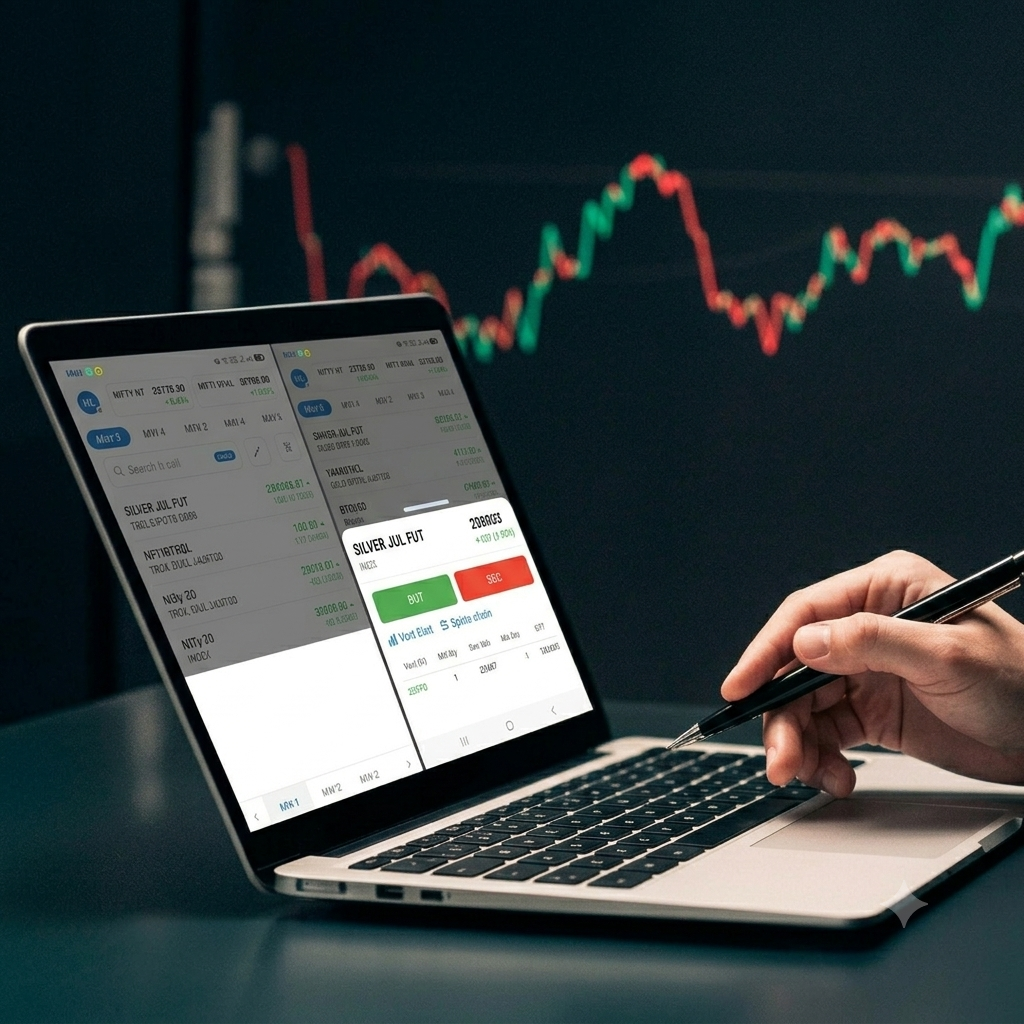
Most people in India start their market journey with stocks. Buy a share, hold it, hope it goes up. Simple enough. But once you get a feel for how prices actually move, you realise something — there’s a whole other layer of the market where traders are doing far more interesting things. That layer is F&O. Futures and options.
At Tradex1.live, the F&O segment is where a big chunk of our users spend their time, and honestly, it’s not hard to see why. You get leverage, you get flexibility, you can profit when markets go up or down, and you can hedge positions you already hold. The catch? You have to actually understand what you’re doing. This page is meant to get you there.
Futures and options are derivative contracts. That word — derivative — just means the contract’s value is “derived” from something else. That something else is called the underlying asset: a stock like Reliance or TCS, an index like Nifty 50 or Bank Nifty, a commodity like gold or crude oil, or even a currency pair.
You’re not buying the stock itself. You’re buying a contract about that stock’s future price.
A futures contract is an agreement between two parties to buy or sell an asset at a fixed price on a specific future date. Both sides are obligated. If you go long on Nifty futures at 24,500 and Nifty closes at 24,800 on expiry, you make the difference. If it drops to 24,200, you eat the loss. No way out — that’s the deal.
An options contract gives you the right, but not the obligation, to buy or sell the underlying at a set price (called the strike price) on or before a set expiry date. For this right, you pay a small upfront fee called the premium. If the trade goes your way, you exercise it. If not, you just let it expire and your loss is capped at the premium. That asymmetry is what makes options so interesting.
There are two basic option types:
That’s the entire foundation. Everything else — straddles, strangles, iron condors, covered calls — is just a combination of these basic pieces.
| Point | Futures | Options |
|---|---|---|
| Obligation | Both buyer and seller are bound | Buyer has a right, not an obligation |
| Upfront cost | Margin (12–20% of contract value) | Premium only |
| Risk for buyer | Unlimited both sides | Limited to premium paid |
| Profit potential | Linear — moves 1:1 with the underlying | Non-linear, can be very high vs cost |
| Best for | Directional bets, hedging large positions | Strategy-based trading, limited-risk plays |
| Complexity | Easier to grasp | More moving parts (premium decay, volatility, Greeks) |
Short version: futures are simpler but riskier in absolute terms. Options are more flexible and let you cap your downside, but you have to understand premium behaviour and time decay. Most beginners on Tradex1.live start with index options — usually Nifty or Bank Nifty — because the contracts are highly liquid and the moves are easier to read than individual stocks.
quick KYC, no waiting around for days.
start small if you're learning. No rule says you need lakhs to begin.
Nifty, Bank Nifty, Sensex options, or CFD derivatives.
check support, resistance, and implied volatility.
set your stop-loss. Don't skip the stop-loss. Ever.
close manually, set a target, or let it run to expiry.
The whole flow takes minutes once you’re set up. And because Tradex1.live offers up to 500x leverage with negative balance protection, you get the upside of large positions without the nightmare of owing money beyond what’s in your account.
Extensive derivatives selection — Equity F&O, index options, commodity, and CFD instruments all under one roof.
Real-time options analytics — Live option chain data, Greeks, IV charts, and open interest tracking.
500x leverage — Among the highest leverage available, with proper risk controls for capital efficiency.
Negative balance protection — Account never goes into the negative. Your maximum loss is your deposited capital.
Risk mitigation tools — Built-in stop-loss, trailing stop-loss, take-profit, and margin alerts.
Expert support — Our team actually understands derivatives. No script readers for margin questions.
Long call / Long put — The starter strategy. Buy a call if bullish, buy a put if bearish. Risk is fixed at the premium. Good for directional conviction.
Covered call — You own the underlying stock and sell a call against it to earn premium income. Works well in sideways markets.
Protective put — You own a stock and buy a put as insurance against a fall. Think of it like an EMI for your portfolio's peace of mind.
Bull call spread / Bear put spread — Buy one option and sell another at a different strike. Caps both your profit and your loss. Lower cost than buying a naked option.
Straddle and strangle — Buy a call and a put when you expect a big move but don't know the direction. Common around budget day, election results, RBI policy days, or major earnings.
Iron condor — A four-leg strategy that profits when the market stays inside a range. Favoured by experienced option sellers who want consistent, smaller wins.
Lot size is fixed by the exchange. You can't buy one share of a Nifty future — you trade in lots. A Nifty lot might be 75 units, a Bank Nifty lot 30, and stock F&O lot sizes vary contract by contract. Always check before placing the order.
Margin for futures is split into SPAN margin (calculated by the exchange based on risk) and exposure margin (an extra buffer). Together they're roughly 12–20% of the contract value. For option buyers, you only pay the premium. For option sellers, you pay a much larger margin because your potential loss is higher.
Expiry dates in India follow a fairly standard pattern. Weekly options expire on Tuesdays (Nifty) and Thursdays (Bank Nifty / Sensex / others) depending on the exchange, while monthly contracts expire on the last Thursday of the month. Always confirm the exact expiry calendar on the NSE or BSE site before trading.
Settlement is T+1 for profits and losses, mostly cash-settled in India. Physical delivery applies to certain stock F&O contracts that are held till expiry.
Futures obligate both parties to complete the trade at expiry. Options give the buyer a choice — exercise or walk away. Futures need higher margin and have linear profit/loss. Options need only the premium for buyers and offer asymmetric payoffs.
It can be, but SEBI data has consistently shown that the majority of retail F&O traders end up losing money. The traders who do well treat it like a serious craft — they study, they journal trades, they manage position size, and they don’t chase tips. Tradex1.live gives you the tools, but the discipline has to come from you.
You can start with as little as a few thousand rupees on Tradex1.live, especially if you begin with option buying. For futures and option selling, you’ll need more because of higher margin requirements. Start small. There’s no prize for going big on day one.
The Indian equity derivatives market runs from 9:15 AM to 3:30 PM, Monday to Friday, with a pre-open session from 9:00 AM to 9:15 AM. Commodity F&O has different hours and runs much later into the evening.
Yes, but start with the basics — index options (Nifty or Bank Nifty), small lot sizes, and only buying strategies at first. Don’t sell naked options until you genuinely understand margin behaviour and risk. Use the demo features and educational content on Tradex.live before going live with size.
Leverage means you control a large contract value with a smaller capital outlay. Tradex1.live offers leverage up to 500x on select instruments. It multiplies gains and losses equally, so use it carefully and always trade with a stop-loss.
No, though it can become gambling if you trade without a plan. The difference is research, risk management, and a repeatable strategy. Treat it like a business and the odds shift in your favour. Treat it like a casino and the market will price you out fast.
The option chain is a table showing all available strike prices for a particular underlying, along with the premium, open interest, volume, implied volatility, and Greeks for both calls and puts. It’s the single most important tool for option traders.
Disclaimer: This content is for educational purposes only and does not constitute investment advice. Equity markets are subject to risk. Read all scheme/offer documents carefully before investing. Consult a SEBI-registered investment adviser for personalised guidance.
Futures and options aren’t for everyone, but if you’ve outgrown plain stock buying and want to actually engage with the market, this is where the real action is. Tradex1.live gives you the platform, the leverage, the analytics and the support. What you bring is the discipline.
No paperwork, No waiting. Get into your first F&O trade in minutes.