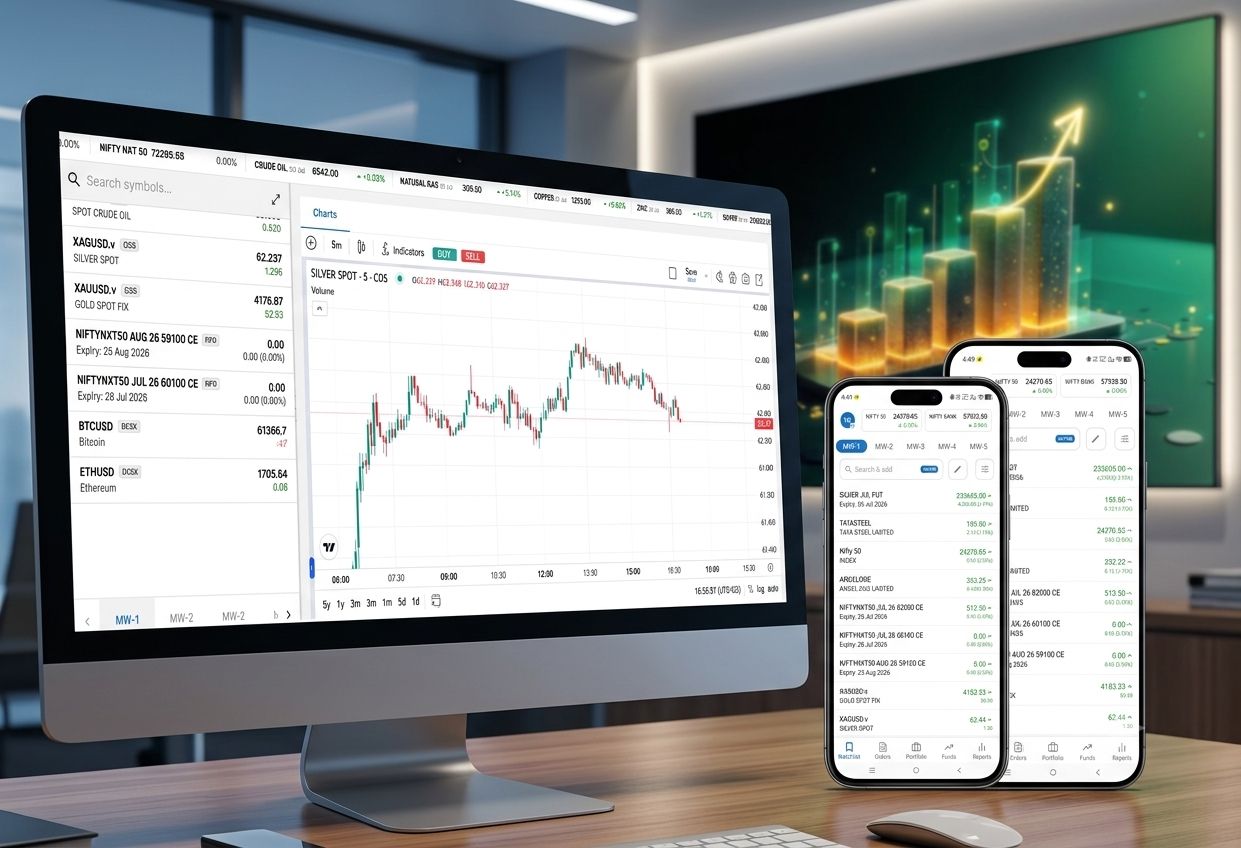
If your portfolio only has stocks, you’re missing half the picture. Equities move with corporate earnings, sentiment and a handful of indices. Commodities move with something completely different — weather in Brazil, OPEC meetings, a war in the Middle East, the dollar index, harvest seasons, central bank gold buying. That’s why traders who actually understand markets keep one eye on Nifty and the other on MCX.
Commodity trading on Tradex1.live gives you direct access to the assets that move the world economy — precious metals, energy, base metals and agricultural products — through a single fast, low-cost platform. Whether you want to hedge against inflation with gold, ride crude oil volatility on a US inventory day, or take a position in silver during a global rally, this is where you do it.
Commodity trading is the buying and selling of contracts based on physical raw materials and natural resources. You’re not actually receiving sacks of wheat or barrels of crude at your doorstep — you’re trading standardised contracts whose value moves with the price of the underlying commodity. Most retail trades are cash-settled, meaning you square off before expiry and the profit or loss is credited in rupees.
In India, commodity trading is regulated by SEBI and happens primarily on two exchanges — the Multi Commodity Exchange (MCX) for metals and energy, and the National Commodity & Derivatives Exchange (NCDEX) for agricultural products. The MCX is by far the larger of the two and is where most active traders spend their time. On Tradex1.live, you get access to all the major commodity instruments traders actually use, with intuitive charts and execution that doesn’t lag when the market gets busy.
People come to commodity markets for three main reasons:
Commodities fall into four broad buckets. Each behaves differently and reacts to its own set of drivers.
Gold and silver are treated as a safe haven — they go up when markets get scared or when central banks buy aggressively. You can trade Gold (1kg), Mini (100g), Guinea (8g), and Silver (30kg) or Mini (5kg) contracts.
Crude oil and natural gas are highly active. Crude is the single most traded commodity on MCX. It’s also the most volatile, moving sharply around OPEC meetings and US EIA inventory data every Wednesday.
Copper, aluminium, zinc, lead, and nickel. These are industrial metals, so their prices depend heavily on global demand, particularly from China and the manufacturing cycle. They offer real opportunities for trend followers.
Cotton, mustard seed, chana, jeera, turmeric and others, traded mainly on NCDEX. These follow weather, monsoon patterns, sowing data, and government policy. Agri trading needs specific knowledge of seasonal cycles.
Wide commodity range — Gold, silver, crude oil, natural gas, copper, and key agri contracts. One platform, every major instrument you’d want.
Competitive commodity prices — Tight spreads and real-time MCX-linked pricing. You’re not getting filled at some delayed quote.
500x margin facility — Among the highest leverage available for commodity trades, meaning a much smaller capital outlay to take meaningful positions.
Zero brokerage — No per-order brokerage on commodity trades. If you trade 50 lots a month, that adds up fast.
Real-time market insights — Live charts, price alerts, open interest data, and quick news access so you’re not reacting half an hour late.
Flexible trading hours — MCX commodity markets stay open well past equity hours (until 11:30 PM IST), so you can trade alongside your regular job.
Fill in details and complete quick KYC. No waiting for days.
Start with a comfortable amount. A few thousand is enough for mini contracts.
Gold and crude oil mini contracts are great starting points.
Check trends and major data release schedules (EIA, RBI, Fed).
Choose buy/sell, set quantity, and most importantly, your stop-loss.
Close manually at your target or trail your stop-loss.
| Segment | Timing (IST) | Notes |
|---|---|---|
| Non-agri (Gold, Silver, Crude, Metals) | 9:00 AM – 11:30 PM | Extends to 11:55 PM in US DST months |
| Agricultural commodities | 9:00 AM – 9:00 PM | Slightly shorter than non-agri |
| Peak liquidity window | 6:30 PM – 11:30 PM | US markets active — best price discovery |
| Trading days | Monday to Friday | Closed on weekends and exchange holidays |
| Feature | Commodity Trading | Equity Trading |
|---|---|---|
| Underlying asset | Physical goods — metals, energy, agri | Shares of listed companies |
| Main exchange | MCX and NCDEX | NSE and BSE |
| Trading hours | 9:00 AM to 11:30 PM | 9:15 AM to 3:30 PM |
| Leverage | Higher — up to 500x on Tradex1.live | Lower, with strict SEBI margin rules |
| Main price drivers | Global demand, USD, geopolitics, weather | Earnings, sector trends, domestic data |
| Tax treatment | Non-speculative business income (most cases) | Capital gains or speculative income |
| Best for | Hedgers, diversifiers, evening traders | Investors and intraday equity traders |
The default for Indian commodity traders. Goes up during global uncertainty, falls when the dollar strengthens or real interest rates rise. Margin requirement is roughly 4–6% of contract value. Highly liquid and the easiest to read for beginners.
More volatile than gold, smaller contract sizes available, often gives a bigger percentage move when precious metals rally. Watch the gold-silver ratio.
The most actively traded commodity in India. Big intraday range, sensitive to OPEC announcements, US inventory data (every Wednesday around 8 PM IST), and geopolitical events. Crude Mini (10 barrels) is the retail favourite.
Highest volatility of the lot. Big moves on US storage data and weather. Profitable when you read it right, painful when you don't. Not for absolute beginners.
The simplest approach. Identify the direction using moving averages (50 and 200 day are popular) and trade with the trend. Works particularly well in crude oil during clear directional phases.
When a commodity is stuck in a sideways range (gold often does this for weeks), buy near support, sell near resistance. Tight stops are non-negotiable.
Position before high-impact events — US EIA inventory data for crude, NFP data for gold, OPEC announcements, RBI policy. Higher reward, but also higher risk if you misread the news.
Commodities often gap up or down at the open after weekend news. Experienced traders position for or fade these gaps once they see follow-through.
Less glamorous but vital for businesses. A jeweller buying gold futures to lock in costs, an importer hedging crude exposure — this is the original purpose of these markets.
Yes. Commodity trading in India is fully legal and regulated by SEBI. All contracts are traded on recognised exchanges — MCX for metals and energy, NCDEX for agricultural commodities. Trade only through SEBI-registered platforms.
With mini contracts and the leverage available on Tradex.live, you can begin commodity trading with a few thousand rupees. A Gold Mini or Crude Oil Mini lot requires significantly less margin than a full-size contract, which makes it accessible for beginners. Start small, get a feel for the volatility, then scale up.
Most experienced traders recommend starting with Gold Mini or Crude Oil Mini on MCX. Gold is easier to read for newcomers because it trends more cleanly. Crude has bigger intraday opportunities but is more volatile. Avoid natural gas and base metals until you’ve built some screen time.
Non-agricultural commodities trade from 9:00 AM to 11:30 PM IST on MCX (extended to 11:55 PM in US daylight saving months). Agricultural commodities on NCDEX trade until around 9:00 PM. Most professional traders concentrate on the 6:30 PM to 11:30 PM window because that’s when US markets are active and liquidity is highest.
Indian commodity futures on MCX are cash-settled for retail traders, so you don’t need a Demat account in the traditional sense. You just need a trading account with a SEBI-registered broker that offers commodity segment access. Tradex1.live handles all of this in one signup.
MCX (Multi Commodity Exchange) deals primarily in non-agricultural commodities — gold, silver, crude oil, natural gas, copper and other base metals. NCDEX (National Commodity & Derivatives Exchange) focuses on agricultural commodities like cotton, soybean, chana, jeera and mustard. MCX is significantly larger by daily turnover.
Profits and losses from commodity trading on recognised exchanges are usually classified as non-speculative business income, which is different from how equity intraday trading is taxed. This treatment can be advantageous because it allows offsetting losses against other business income. Consult a tax advisor for your specific situation.
Yes. The vast majority of retail commodity trades in India are cash-settled — you simply square off your position before the contract expires and the profit or loss is settled in cash. Physical delivery is mostly used by businesses with actual physical exposure.
Over-leverage. Commodity markets offer high leverage, which is fantastic when you’re right and devastating when you’re wrong. Sudden geopolitical news or surprise inventory data can move prices several percent in minutes. Always use a stop-loss, size positions conservatively, and never put your entire capital on a single trade.
Commodities open up an entire side of the market that most retail traders ignore — and that’s exactly why there’s still real opportunity in them. Tradex1.live gives you wide commodity coverage, 500x margin, zero brokerage, real-time data and extended evening hours, all on one clean platform. The rest is up to you.