Stocks rise and fall on company news. Commodities rise and fall on something bigger — global supply and demand for the materials civilisation actually runs on. Gold reacts to inflation and central bank policy. Crude oil reacts to wars, OPEC decisions and US storage data. Wheat and cotton react to monsoons. These are the assets that move when geopolitics shift, when economies expand, when seasons change.
That’s why a portfolio with only stocks is exposed to one type of risk — corporate and equity-market risk. A portfolio that also has gold, silver, crude oil and other commodities is exposed to fundamentally different drivers, which is exactly what diversification is supposed to do. Commodities aren’t an exotic side-bet; they’re a core asset class that institutional investors have used for as long as markets have existed.
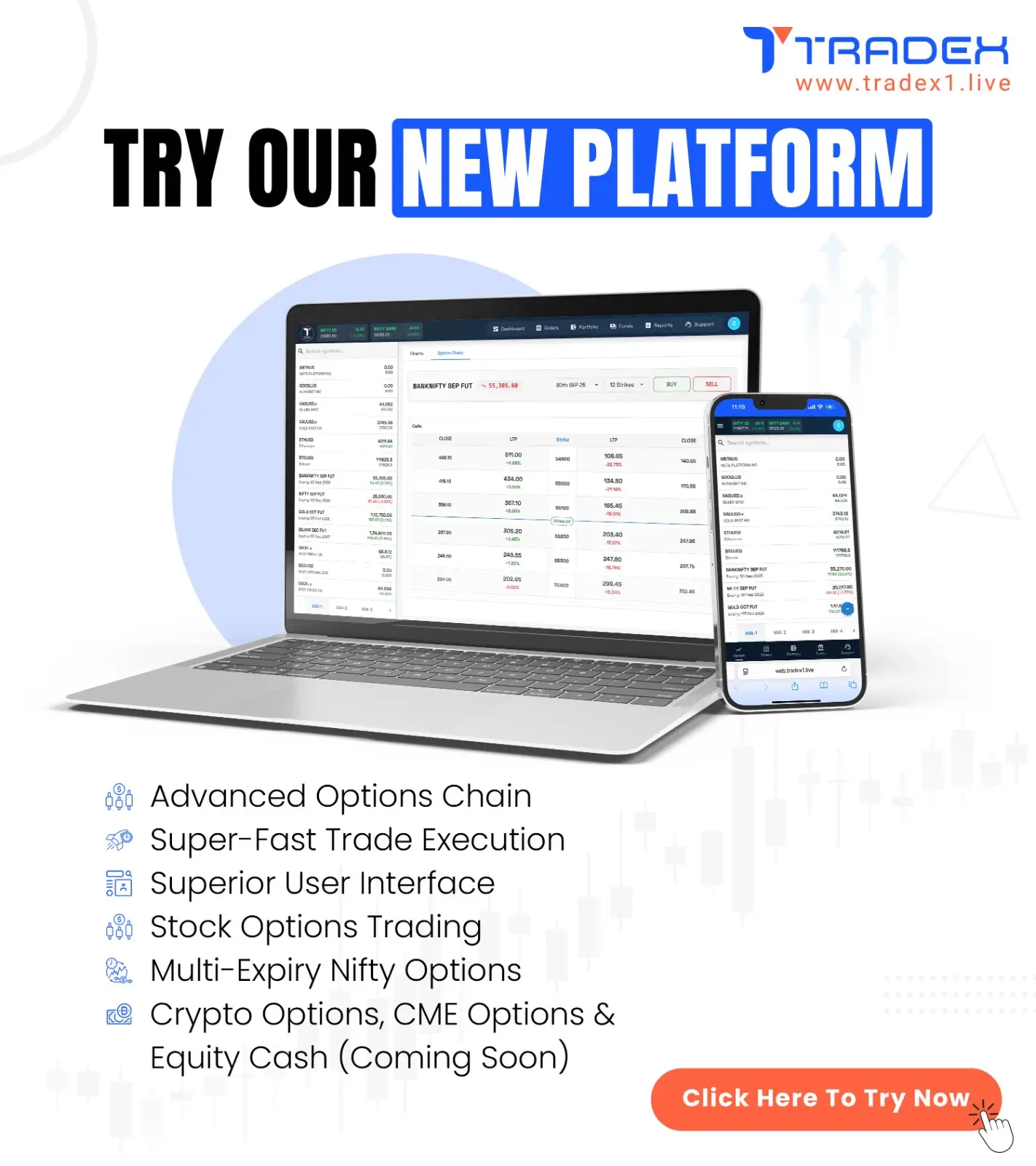
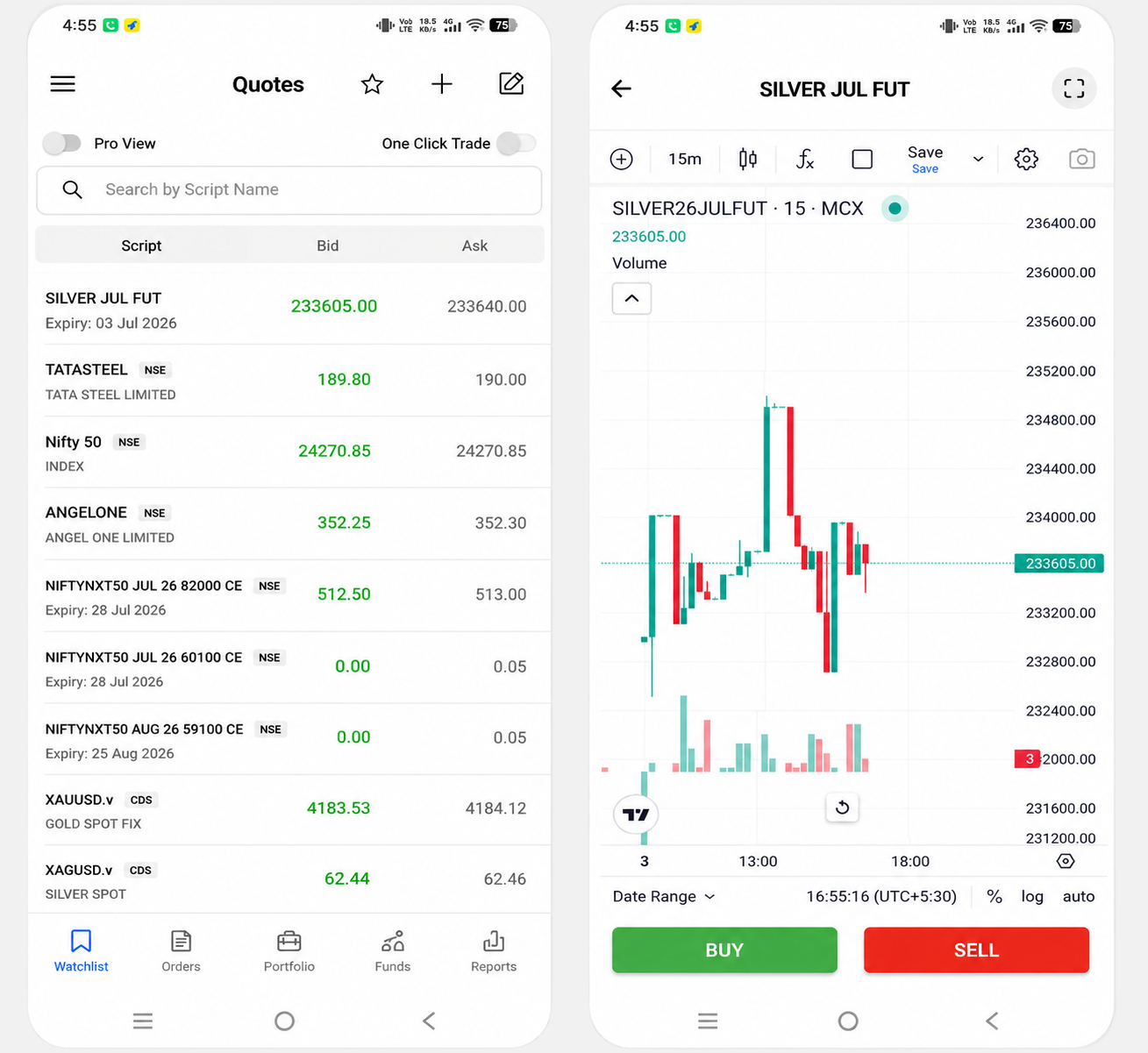
Tradex1.live gives you direct access to the major commodity instruments traded globally — precious metals, energy, base metals and agricultural products — through a single fast platform with live MCX-linked pricing, low margin requirements, and extended trading hours that fit around a regular workday. This page walks you through each commodity, what makes its price move, and how to think about it as part of your trading or investment portfolio.
A commodity is a basic raw material or natural resource — interchangeable, standardised, and used as an input by industries and consumers worldwide. A barrel of crude oil from one well is the same as a barrel from another (within grade specifications). An ounce of pure gold is identical regardless of where it came from. This interchangeability — what economists call “fungibility” — is what allows commodities to be traded on standardised global contracts.
Commodities are typically grouped into four broad categories, each with its own price drivers and behaviour:
In India, commodities are traded primarily on two exchanges — MCX (Multi Commodity Exchange) handles metals and energy, while NCDEX (National Commodity & Derivatives Exchange) handles most agricultural commodities. Both are regulated by SEBI.
Why it matters: Gold is the world’s primary safe-haven asset. When markets get scared, when central banks print money, when the US dollar weakens, gold tends to rise. Central banks themselves are major buyers — the RBI and other emerging-market central banks have been adding to their gold reserves consistently for years.
Main price drivers: US real interest rates (the biggest single factor — gold falls when real rates rise), the US dollar index, central bank buying, geopolitical tensions, inflation expectations, and ETF flows from large funds.
Indian context: India is one of the world’s largest gold consumers — wedding seasons (October–February) and the festive period (Diwali, Akshaya Tritiya) drive consistent physical demand. This gives Indian gold prices a slight premium to global prices most of the year.
MCX contracts: Gold (1 kg lot), Gold Mini (100 g), Gold Guinea (8 g), Gold Petal (1 g). Gold Mini is the most popular among retail traders — manageable lot size with full liquidity.
Why it matters: Silver behaves like gold’s more volatile cousin. It’s both a store of value and an industrial metal — heavily used in solar panels, electronics, and electric vehicles. So silver gets a double tailwind in periods when both safe-haven demand and industrial demand rise together.
Main price drivers: Gold price (silver typically follows gold but with bigger percentage moves), industrial demand particularly from solar and EV sectors, mining supply, and the gold-silver ratio (a long-watched indicator of relative value).
MCX contracts: Silver (30 kg lot), Silver Mini (5 kg), Silver Micro (1 kg). The Silver Mini contract is what most retail commodity traders use.
Why it matters: Crude is the most actively traded commodity on MCX. It’s also the one with the cleanest set of fundamentals — you have OPEC meetings (eight times a year), weekly US EIA inventory data (every Wednesday around 8:00 PM IST), geopolitical events, and global demand signals from manufacturing indices. The information flow is constant and the price reacts visibly to each catalyst.
Main price drivers: OPEC+ production decisions, US inventory data, geopolitical events (Middle East tensions, Russia-Ukraine, shipping disruptions), economic growth indicators, USD strength, refining margins, and seasonal demand (summer driving season, winter heating).
MCX contracts: Crude Oil (100 barrels lot), Crude Oil Mini (10 barrels). The Mini contract is the retail favourite — strong liquidity with manageable margin requirements.
Daily rhythm: Crude tends to be quiet during the Indian morning session and gets active in the evening as US traders come online (around 6:30 PM IST). The 8:00 PM EIA window every Wednesday is the biggest single event in the week.
Why it matters: Natural gas is the highest-volatility commodity on MCX. Daily ranges of 5–10% are not unusual. It’s used heavily for power generation, industrial processes, and heating, which makes it extremely weather-sensitive — cold US winters spike demand and price, warm winters do the opposite.
Main price drivers: US weekly storage data (Thursday around 8:00 PM IST), weather forecasts (especially US winter and summer extremes), LNG export trends, supply disruptions, and seasonal demand patterns.
MCX contracts: Natural Gas (1,250 mmBtu lot), Natural Gas Mini (250 mmBtu). Both are highly volatile — best left until you’ve built experience with crude oil first.
Why it matters: Copper is sometimes called “Dr. Copper” because its price is considered a reliable indicator of global economic health. Used in electrical wiring, plumbing, construction, electric vehicles, and renewable energy infrastructure. The EV and renewable energy transition is structurally bullish for long-term copper demand.
Main price drivers: Chinese manufacturing and construction data, global PMI indices, USD strength, mine supply (Chile and Peru are the biggest producers), and inventory levels at LME warehouses.
MCX contracts: Copper (2,500 kg lot), Copper Mini (250 kg).
Why it matters: Light, durable and used everywhere — from beverage cans and packaging to aerospace components and EV bodies. Aluminium is energy-intensive to produce, so its price is sensitive to energy costs and electricity prices.
Main price drivers: Energy prices (electricity is the biggest input cost), Chinese production and policy, global manufacturing demand, supply disruptions, and LME inventory levels.
MCX contracts: Aluminium (5,000 kg lot), Aluminium Mini (1,000 kg).
Why they matter: Zinc is mostly used in galvanising steel against rust — its price moves with construction and infrastructure demand. Lead is used heavily in batteries (especially in automotive and backup power applications). Nickel is critical for stainless steel and, increasingly, for EV batteries — its price has been highly volatile as the EV transition unfolds.
Main price drivers: Industrial demand cycles, China-specific drivers, EV battery demand (for nickel especially), supply disruptions, and global manufacturing PMI data.
MCX contracts: Zinc, Zinc Mini, Lead, Lead Mini, Nickel.
Commodities don't move in lockstep with stocks. When equity markets crash, gold often rises. When inflation surprises higher, commodities generally outperform paper assets.
Commodities are physical assets. When the value of currency falls, the price of physical goods denominated in that currency rises. Gold and oil are the historical inflation hedges.
When OPEC cuts production, when wars break out, when monsoons fail — commodities respond directly, creating unique profit opportunities.
Commodity markets run until 11:30 PM IST on MCX, which means you can trade after your regular workday ends.
Commodity margin requirements are typically 4–10% of contract value. With Tradex1.live's leverage facility, this efficiency is amplified further.
Commodity trends, when they form, tend to persist longer than stock trends because they're driven by physical supply-demand imbalances.
| Commodity | Lot Size | Tick Size | Margin |
|---|---|---|---|
| Gold | 1 kg | ₹1 | 4–6% |
| Gold Mini | 100 g | ₹1 | 4–6% |
| Silver | 30 kg | ₹1 | 6–8% |
| Silver Mini | 5 kg | ₹1 | 6–8% |
| Crude Oil | 100 barrels | ₹1 | 8–12% |
| Crude Oil Mini | 10 barrels | ₹1 | 8–12% |
| Natural Gas | 1,250 mmBtu | ₹0.10 | 10–15% |
| Copper | 2,500 kg | ₹0.05 | 6–10% |
| Aluminium | 5,000 kg | ₹0.05 | 6–10% |
| Zinc | 5,000 kg | ₹0.05 | 6–10% |
Margin percentages are indicative and change based on volatility and exchange rules. Always check live margin requirements on the Tradex1.live platform before placing the trade. Mini contracts are usually the right starting point for retail traders because they offer the same exposure mechanics with lower absolute capital commitment.
Commodities are event-driven. Knowing the major scheduled events keeps you from being blindsided by sudden moves:
Pro tip — set calendar alerts for these events on your phone. The traders who consistently take money out of commodity markets are usually the ones positioned before these events or who don't take the bait of trading into them blindly.
| Event | Gold | Silver | USD Pair |
|---|---|---|---|
| Rising inflation | Strong | Weak | Mixed |
| Falling interest rates | Mixed | Strong | Weak |
| Geopolitical crisis | Strong | Weak | Risk-off |
| Growth | Strong | Strong | EM Up |
| USD Weakness | Strong | Mixed | Direct |
A commodity is a basic raw material or natural resource that’s used as an input by industries or consumers — like gold, silver, crude oil, natural gas, copper, wheat or cotton. Commodities are standardised and interchangeable, which is what allows them to be traded on global exchanges in the form of standardised contracts.
Tradex1.live offers a wide range of commodities including precious metals (gold, silver), energy (crude oil, natural gas), base metals (copper, aluminium, zinc, lead, nickel), and key agricultural commodities. Both standard and mini contract sizes are available, so retail traders can pick contracts that suit their capital.
Most experienced traders recommend starting with Gold Mini or Crude Oil Mini on MCX. Gold tends to trend cleanly and is easier to read for newcomers. Crude offers bigger intraday opportunities but is more volatile. Mini contracts are key for beginners because they require lower margin and let you size positions more conservatively.
Gold prices change every second based on global supply and demand. Major drivers include US real interest rates, the strength of the US dollar, central bank buying or selling, geopolitical events, inflation expectations, and ETF flows. In India, festival and wedding-season demand adds a local layer on top of the global price.
In the short term — US weekly inventory data, OPEC+ production decisions, and geopolitical events (Middle East tensions, Russia-Ukraine, shipping route disruptions) drive the biggest moves. In the medium term — global economic growth (affecting demand) and the production trajectory of US shale matter most. Crude is one of the most informationally rich commodities to trade.
Spot price is the price for immediate physical delivery (like what you’d pay at a jewellery shop or fuel station). Futures price is the price for delivery at a future date. Futures prices factor in storage and financing costs, which is why they’re usually slightly different from spot. Commodity trading on MCX happens through futures contracts.
Not unless you specifically want to. The vast majority of retail commodity trades in India are cash-settled — you simply square off your position before the contract expires and the profit or loss is settled in cash. Physical delivery is used by businesses with actual physical exposure (jewellers, refiners, exporters) and not by retail traders.
With mini contracts on MCX, you can start commodity trading with as little as a few thousand rupees. A Crude Oil Mini contract requires about ₹10,000–₹15,000 in margin (varies with volatility), and Gold Mini around ₹35,000–₹50,000. The leverage available on Tradex1.live can bring effective capital requirements down further.
Non-agricultural commodities (gold, silver, crude oil, natural gas, base metals) trade on MCX from 9:00 AM to 11:30 PM IST — extended to 11:55 PM during US daylight saving months. Agricultural commodities on NCDEX trade until around 9:00 PM. Peak liquidity is usually 6:30 PM–11:30 PM, when US markets are active.
Yes. Commodity trading in India is fully legal and is regulated by SEBI. All trades happen on recognised exchanges — MCX for metals and energy, NCDEX for agricultural commodities. Always trade through SEBI-registered platforms and brokers.
Not inherently — but commodities can move faster and are typically traded with higher leverage, which amplifies both gains and losses. Specific commodities (natural gas, crude oil in volatile periods) are riskier than blue-chip stocks. Gold is often considered safer than equity over long periods. Risk depends on the specific commodity, position size, and use of leverage.
Profits and losses from commodity trading on recognised exchanges are usually classified as non-speculative business income, which is different from equity intraday trading. This treatment can be advantageous because it allows offsetting losses against other business income. Always consult a CA for your specific tax situation.
Yes — this is actually one of the main practical advantages of commodities over equities. The evening session from 6:30 PM to 11:30 PM IST is when most active commodity traders work, and it aligns perfectly with post-work hours for salaried professionals. Many successful Indian commodity traders work full-time jobs and trade the evening session consistently.
MCX (Multi Commodity Exchange) handles primarily non-agricultural commodities — gold, silver, crude oil, natural gas, copper and other base metals. NCDEX (National Commodity & Derivatives Exchange) focuses on agricultural commodities like cotton, soybean, chana, jeera and mustard. MCX is significantly larger by daily turnover.
This page covers what each commodity is and why it matters. For practical trading approaches — strategies, technical setups, intraday timing — see our companion page:
Commodity Trading Guide — strategies, MCX vs NCDEX, trading hours and how to actually execute commodity trades successfully.
For traders using leverage on commodities, also explore:
Margin Trading — how to use leverage responsibly on commodity positions.
Futures and Options — derivative contracts on commodities for hedging and directional plays.
Commodities give you exposure to a completely different layer of the global economy — and with that comes both the opportunity to diversify away from equity-only risk and the chance to trade fast-moving markets that work in the evening hours when most people are free. Tradex1.live brings together the wide commodity range, competitive pricing, real-time market data, secure execution and the extended trading hours that serious commodity traders need. The platform is ready. The market is moving.