Lotering around a stock exchange market, have you ever heard the term ‘dabba trading’? Ever wondered what it means? Is it safe or legal? What advantages or disadvantages come with it? It also raises a question of whether the investors should be worried about the trading practice. In simple terms, Dabba Trading refers to a trading practice which often takes place outside the direct supervision of the Indian stock exchanges, such as the NSE or BSE. Regardless of its nature, many investors find it to be lucrative because of the informal structure of the trading practice. However, it is essential for the investors to know about the attributes and the mechanisms of the trading practice, which helps them to make informed decisions in terms of making financial decisions and safeguarding their financial asse
Understanding Dabba Trading
In the most ordinary terms, ‘Dabba’ refers to a box in Hindi. For example, if an individual is trading for Gold, it gets recorded in their own personal notebook. Dabba trading is beyond the formal market infrastructure, which ensures flexibility in terms of withdrawal and deposits of the funds generated by the investors during a trade. In Dabba Trading, the investors have the liberty to settle profit and loss directly based on the real-market movements, which ensures profitability for the investors amid price fluctuations. Formal market structure encompasses certain regulations, which are subject to tax deductions and scrutiny; on the other hand, Dabba Trading is free from any strict taxation rules. If we have to look into the understanding of Dabba Trading through the lenses of a two-year-old kid, we can say that Dabba Trading refers to providing an individual with funds and expecting that individual to make use of those funds in market-linked activities. The historical roots of Dabba trading are deeply embedded in the traditional values of trust and less reliance on formal market infrastructure, which often comes with complexities.
How does Dabba Trading work
Apart from understanding the pros and cons, it is important for the investors to have a brief idea about how dabba trading takes place to make an informed decision about their trading aspirations. In the simplest form, if a client buys shares worth ₹100 and the share later moves to a price of ₹110, the broker has an advantage of gaining ₹1000 profit. The transactions take place based on the real-time market insights, which help the brokers to develop a relationship with the clients based on mutual trust. For instance, Tradex has replicated the dabba trading system by providing real-time market insights to its traders, which ensures that they are engaged with the price fluctuations, which helps them with secure investment decisions. The major perk of Tradex in the replication of the dabba trading system is associated with its user-friendly digital interface, which is relevant for the traders in the context of tracking market movements amid economic volatility.
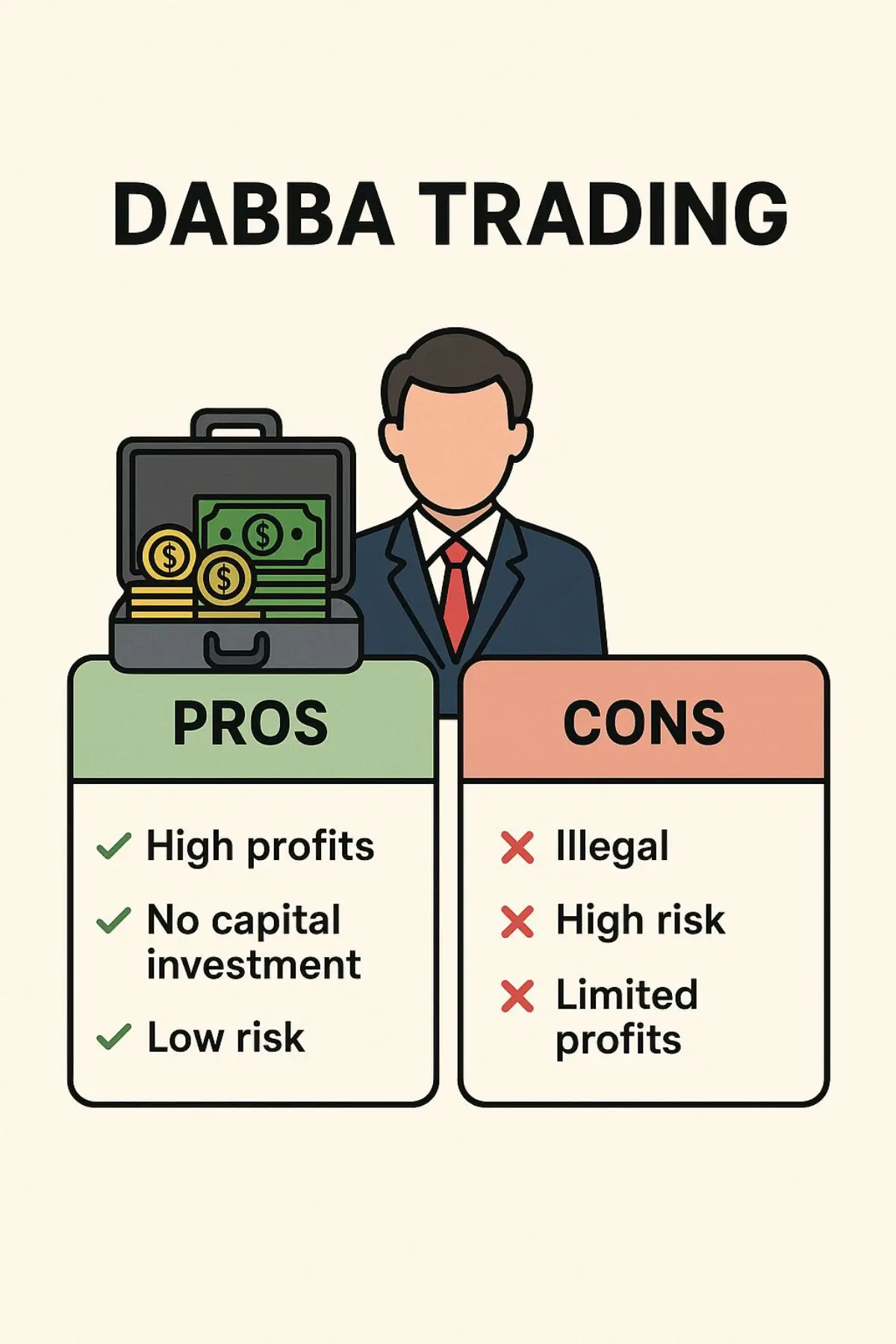
Dabba Trading Pros
1. Absence of Brokerage or Transactional Charges: Since the traders are not associated with any formal market structure, it helps with the exemption of traditional brokerage fees, such as securities transaction taxes, GST or any other fees. Digital platforms such as Tradex.live are helping traders to trade effectively without the reliance on any brokerage fees or other additional taxes. 2. Traders are entitled to a much higher leverage: Compared to the conventional stock exchange brokers, dabba traders are equipped with a much higher margin, which helps them to capture lucrative markets at a minimal investment. In this context, platforms similar to Tradex have adopted a more systematic approach in terms of providing a 500x margin to the traders without compromising on trading integration. 3. Easily Accessible Accounts: In the context of box or dabba trading, the documentation process is not heavily formal, which ensures ease in account accessibility. Formal stock exchange institutions come with a heavy documentation process, which often results in delays, and traders can potentially lose market opportunities. On the other hand, platforms such as Tradex have ensured the opening of a trading account through simple steps such as registration with minimum documentation, fund deposit and gradually the traders can take it from there. 4. Free from the hassle of taxation: Investors trading without the direct supervision of a stock exchange institution imply no formal registration of assets in BSE or NSE, which ensures that the investors can enjoy maximum profits. 5. Speedy settlements: In the world of trading, speed is a major aspect of accelerating profit outcomes and box trading benefits traders with easy and speedy cash settlements. For instance, Tradex has offered investors 24/7 accessibility to funds, which ensures that they can deposit or cash according to their convenience, without compromising on the profits. 6. Partial Privacy: Dabba trading comes with the pros of partial privacy. For instance, it helps traders to keep their profit transactions hidden from any bank regulators and taxation authorities.Cons of Dabba Trading
Dabba trading platforms can be lucrative for investors, and amid the volatile market conditions, investors are prone to invest through real-time tracking. However, it poses a huge risk for the investors if they are indulging in this practice without an understanding of the potential risks and consequences that come with it.
1. Dabba Trading in India is illegal: Since the trading system is not registered under any formal institution, it comes with certain legal consequences, such as fines and is prone to criminal allegations against the traders.
2. Not backed by any legal protection: All the trading that takes place under Dabba Trading is not registered with any authorised body in India; hence, in case of any fraudulent activities, the trader cannot launch any complaints to the registered body, such as BSE or NSE.
3. Poses a high risk of money laundering: Dabba trading is associated with high money laundering since the traders are not entitled to any formal documentation, which often poses a risk of criminal act of money laundering.
Is Dabba Trading Legal or Illegal?
The legality of Dabba trading can be considered as a clashing trading philosophy with the formal market structures; however, it can be considered effective based on the speed and efficiency promised by the trading system. Amid the formal finance traditions, Dabba trading follows an informal investment option, which can be considered debatable; however, it ensures the trader’s autonomy over their financial decision-making. Since it takes place outside the formal structure of a financial institution, the trading practice gets a little deviated from what people have conventionally known as trading.
Concluding Thoughts on Dabba Trading
The Dabba trading is a unique blend of a flexible and convenient trading approach. Since it functions outside the conventional market structure of a financial institution, the approach offers convenience in trading to its traders. Formal finance structure comes with complexities, such as high taxation and a lack of a flexible approach to adapt to the changing market norms. On the other hand, Dabba Trading has changed the trading landscape of India by offering convenience and providing real-time market insights to the traders for better decision-making.
Also read : Download app: Android User | IOS User | Web Trader
Reach Tradex.live: https://tradex.live/links