If you’re new to trading, you face an early choice. Do you trade currencies or stocks? Both offer opportunities, but they work differently. Understanding the difference between forex and stock trading helps you pick the path that fits your lifestyle, risk tolerance, and goals. I’ve traded both, and in this guide I’ll walk you through the key contrasts so you can decide which one makes sense for you.
What You Actually Trade
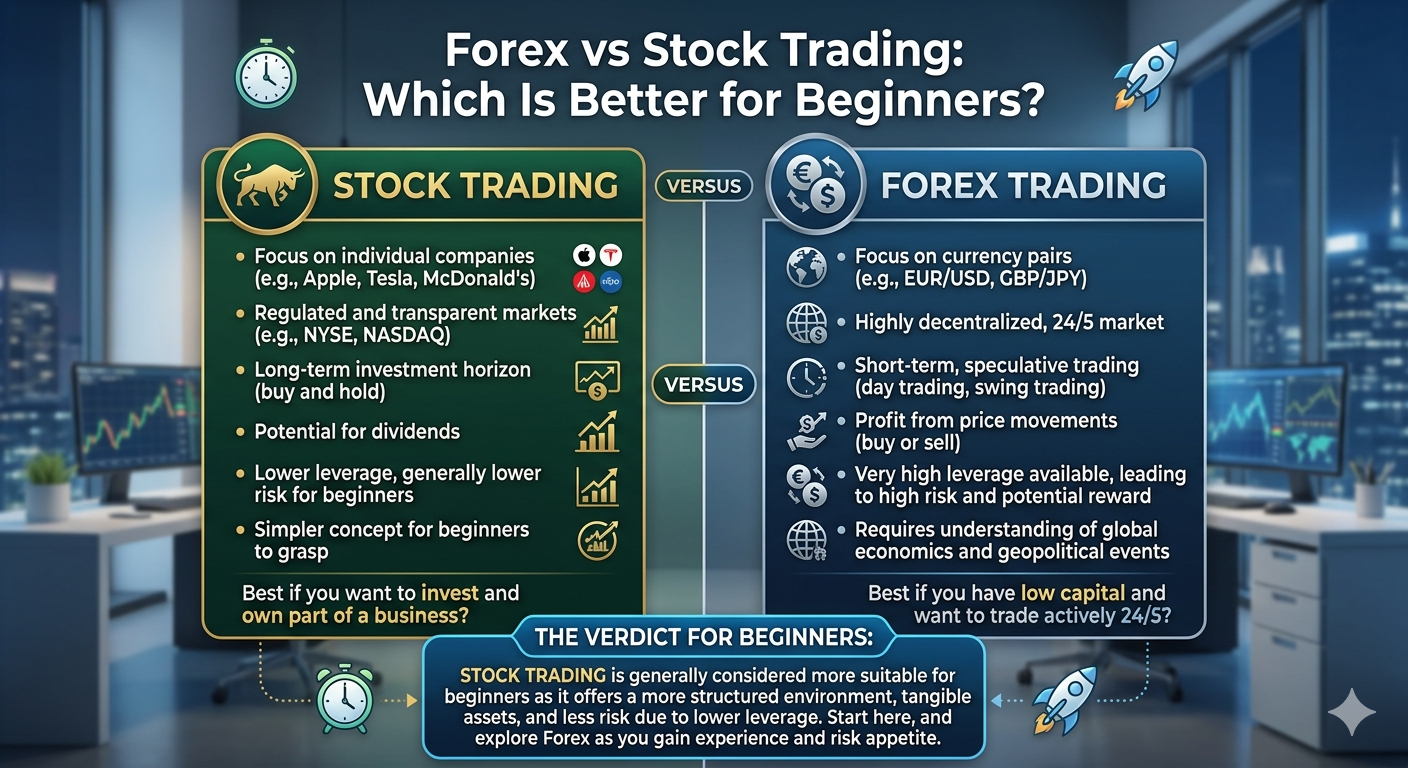
Forex is the foreign exchange market. You buy one currency and sell another. Think EUR/USD or GBP/JPY. You’re betting on one currency getting stronger against the other.
Stocks are shares of companies. When you buy a stock, you own a piece of that business. Your profit comes from the share price rising or from dividends.
That’s the first big difference between forex and stock trading. In forex you trade pairs. In stocks you trade individual companies.
Market Hours and Your Schedule
Forex runs 24 hours a day, five days a week. The market opens Sunday evening and closes Friday evening. You can trade during Asian, London, or New York sessions. If you have a day job, you can trade in the evening when the US market is active.
Stock markets have fixed hours. In India, the NSE and BSE run from 9:15 AM to 3:30 PM. If you work during those hours, you either trade on your lunch break or stick to after‑hours sessions which have lower liquidity.
This timing difference matters a lot. Many beginners prefer forex because they can trade around their existing schedule.
Leverage and Margin
Forex brokers offer high leverage. You might control $100,000 with only $1,000 in your account. That amplifies both gains and losses. In forex, leverage is part of the package.
Stock trading also offers leverage, but typically at lower ratios. In India, intraday stock leverage is capped around 3‑5 times your capital. For delivery trades, you usually need full payment.
The difference between forex and stock trading here is stark. Forex gives you more firepower, but also more risk. One bad trade can wipe a significant portion of your account if you overleverage.
Number of Choices
In stocks, you have thousands of companies to choose from. Each has its own financial reports, management, and industry trends. You need to analyze the company itself.
In forex, you focus on about 8 major currencies. Most beginners stick to a handful of pairs like EUR/USD or USD/JPY. Instead of analyzing companies, you analyze economies, interest rates, and geopolitical events.
Many beginners find forex simpler because they don’t have to pick individual stocks. You learn a few currency pairs and focus on the economic calendar.
Volatility and Risk
Both markets can move sharply, but the nature of moves differs. Stocks can gap overnight on earnings or news. Forex moves more continuously, though major news events can cause spikes.
Leverage makes forex riskier for the same account size. A 1% move in a stock might lose you 1% of your capital. A 1% move in a forex pair with 50:1 leverage loses you 50% of your capital.
Understanding this difference between forex and stock trading is critical for beginners. You must size your positions carefully in forex.
Costs and Fees
Stock trading often involves brokerage fees, exchange fees, and possibly account maintenance charges. In India, many brokers offer zero brokerage for delivery trades but charge for intraday.
Forex brokers typically make money through the spread. The spread is the difference between the buy and sell price. No commission on most trades, though some brokers offer commission‑based accounts with tighter spreads.
For small account sizes, forex can be cheaper because you don’t pay per trade fees.
Which Is Easier to Learn?
Stock trading requires understanding company fundamentals, reading balance sheets, and tracking earnings. You can also trade stocks purely with technical analysis, but many beginners mix both.
Forex leans heavily on technical analysis and economic news. You don’t need to analyze individual companies. That simplifies the learning curve.
Many beginners find forex more accessible because the learning materials are abundant and the market structure is uniform across pairs.
Time Commitment
Swing trading stocks can be done with a few hours per week. Day trading stocks requires being present during market hours.
Forex offers flexibility because you can trade any session. But the 24‑hour nature also tempts people to overtrade. You need discipline to pick your hours and stick to them.
My Take for Beginners
If you want to trade part‑time and prefer analyzing economies over companies, forex is a strong choice. If you enjoy following specific industries and want to own a piece of a business, stocks may suit you better.
The real difference between forex and stock trading comes down to leverage, hours, and what you enjoy studying. Both can be profitable, but both require risk management.
How Tradex1.live Helps You Start
Tradex1.live gives you access to both markets. You can trade forex pairs and stock indices from one platform. The interface is clean, and the demo account lets you practice without risk. If you’re still unsure which path fits, try both on demo. See which one feels natural.
Tradex1.live also provides charting tools, indicators, and educational resources to help you understand the difference between forex and stock trading and apply that knowledge.
Your Next Step
Pick one market and focus. Learn its patterns. Master a few setups. Risk small. Grow slowly. Whether you choose forex or stocks, consistency beats excitement.
Risk Disclaimer: Trading financial instruments on margin carries a high level of risk. It may not be suitable for all investors. You could lose some or all of your invested capital. Ensure you understand the risks and seek independent advice if needed.