On September 25, 2025, HSBC made a historic announcement: it had tested the first known quantum-enabled algorithmic trading application in partnership with IBM, specifically for bonds. This milestone indicates that quantum computing is no longer just theoretical — it is starting to impact how trades may be executed in the real world. This indicates to traders that the playing field is shifting, and being prepared for this future will be essential for a trader’s long-term success.
Platforms like Tradex1.live are already preparing traders to rapidly utilise market technology, but before discussing unpa, let’s examine what IBM did and why it matters.
Breaking Down the HSBC-IBM Breakthrough
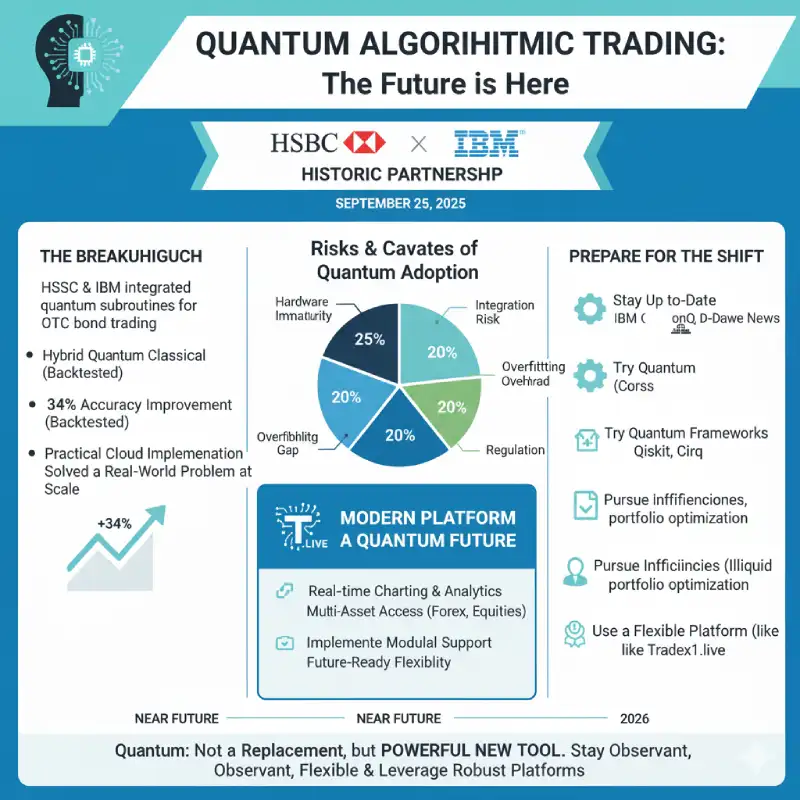
HSBC’s research team partnered with IBM to incorporate quantum subroutines into their preexisting classical trading models. The scope of work focused on the OTC bond market, where trades are not only more complex and less liquid, but also more difficult to price than equities.
Here’s what they accomplished:
- Hybrid Quantum-Classical Approach — HSBC implemented using quantum computing alongside conventional classical algorithms to predict the probability of a customer inquiry being filled at the quoted price.
- 34% Improvement — Backtesting using production-scale data demonstrated that hybrid approaches exhibited as much as a one-third improvement in accuracy over classical approaches.
- Practical Implementation — This was not just theoretical. HSBC completed the work that enabled them to access IBM’s quantum processors via the cloud, cementing that quantum resources can be integrated into current workflows in finance.
- Proof of Scale — HSBC emphasised this as solving a real business problem at scale — not in a lab.
In summary, the bank has just established that quantum computing can provide traders with an even sharper edge in pricing, execution, and risk modelling.
Why This Development Matters to Traders
Quantum Won’t Take the Place of Classical – But will Offer Depth
Quantum computing does not rewrite the rules of trading; it builds on them. Classical algorithms remain deeply useful, but quantum subroutines are improving performance when optimising over large solution spaces, or when pattern recognition is difficult because of noise.
The Edge is Changing
For years now, algorithmic trading has been defined by speed, latency, and machine learning. The definition of sophistication is changing. If quantum routines continue to improve prediction accuracy and firms using them are on the leading edge, firms using last-generation models will see their alpha eroded.
Pioneers Create the Frame
Bond markets are complex and inefficient, making them ripe candidates for quantum adoption. If these results can be replicated, you can imagine derivatives desks, FX trading, or portfolio optimisation groups experimenting soon. The clock is ticking.
Tradex1.live: A Modern Platform for a Quantum-Driven Future
As quantum experiments progress from a research-oriented atmosphere to the marketplace, traders may demand platforms that allow for speed, flexibility, and multi-asset access. Consequently, tools like Tradex1.live may fulfil those demands.
- Real-time charting and analytics provide the ability to execute ideas in real time.
- A stable environment with multi-asset access, from forex to equities, allows for diversification and stress-testing a strategy.
- Algorithmic signal support provides an environment for strategy experimentation using cutting-edge techniques.
Although quantum resources are not yet available to retail traders, being on a platform that operates in real time with rapid evolution is a prudent decision to be future-ready.
How Traders Should Prepare for the Quantum Shift
Here are some actionable things traders can do right now:
- Stay up-to-date: Listen for news from quantum players (IBM, Google, IonQ, D-Wave). Knowing what is happening early allows you to guess where the industry could be going.
- Try the Quantum Frameworks: Free toolkits like Qiskit or Cirq allow you to dabble with quantum concepts without needing a PhD to get familiar.
- Implement Modular Frameworks: Build your trading systems to use “plug-in” models, and it will allow for easier tweaks to quantum-enhanced modules later on.
- Pursue Inefficiencies: Quantum will deliver where classical models are inefficient — illiquid bonds, option pricing in an environment with high volatility, and portfolio optimisation.
- Use a Flexible Platform: Your experience using agile, trader-centred platforms (as opposed to being stuck using clunky institutional platforms) means that when hybrid quantum methods trickle down, you will quickly adapt.
The Market Impact: What to Expect in the Near Future
- Bond Trading Serves as a Proving Ground: Expect further developments on the fixed income side of the markets, as inefficiencies provide a fertile breeding ground for quantum algorithms.
- Derivatives and FX Next: As quantum methods develop, likely that options pricing and foreign exchange market participants will incorporate these methods.
- Machine Learning Convergence: Traders will see “quantum-augmented AI” systems develop, where quantum hardware will accelerate machine learning models.
- Regulatory Response: With additional, more opaque models entering the marketplace, regulators may respond with tightened rules around auditability and transparency.
- The Acceleration of the Arms Race: Just as low-latency trading separated winners from losers, so too could access to quantum-augmented strategies create a new divide.
Risks and Caveats to Consider
Quantum technology is exciting, but it should not be viewed as a silver bullet. Traders must consider the following caveats:
- Hardware Immaturity: Quantum processors today are still noisy, have limited qubit counts, and are prone to errors.
- Integration Overhead: There will be additional latency and costs to integrate quantum and classical workflows.
- Overfitting Risk: More powerful models do not necessarily result in better fitting; being too close to historical data is still a risk.
- Accessibility Gap: Not all firms (particularly smaller firms) will have the capital to experiment early.
- Regulation: The added complexity may result in additional compliance requirements.
In summary, the technology is powerful but not yet flawless.
The Road Ahead for Traders
As we near the end of 2025 and turn to 2026, here are some signs to be aware of:
- New Bank Pilots: Other global banks may quickly follow HSBC’s precedent.
- Hardware Jumps: IBM and its competitors will soon report qubit counts and error rates improving.
- Real Life Case Studies: Again, outside of bonds, we can apply this to portfolio risk across asset classes, and also in derivatives.
For traders and market participants, the note here is to transition our mindset: when developing our strategies, we need to consider not only data and speed, but also this new type of adaptive data analysis using new computational capabilities.
Final Thoughts — and a Practical Takeaway
Quantum-enabled trading is no longer a far-off notion. HSBC’s partnership with IBM highlights that actual trading workflows will already have hybrid workflows. This doesn’t mean every trader needs to jump into quantum — it does mean that being observant, flexible, and open to new paradigms remains pivotal.
Meanwhile, platforms like Tradex1.live are offering immediate benefits for trading: multi-asset access, speedy analysis and algorithmic options. It may not be a quantum engine, but it is the kind of nimble platform that prepares market participants to adopt the best innovations — be it quantum, AI or a new frontier.
At the end of the day, do not think about quantum as a replacement for your trading strategies. Think about it as the next tool to put into the toolbox. If you build a flexible approach, be open to learning and leverage robust platforms. You will be prepared for the future of trading.
Download our glitch free app: Android User | IOS User | Web Trader
Reach tradex.live https://tradex.live/reach-links/