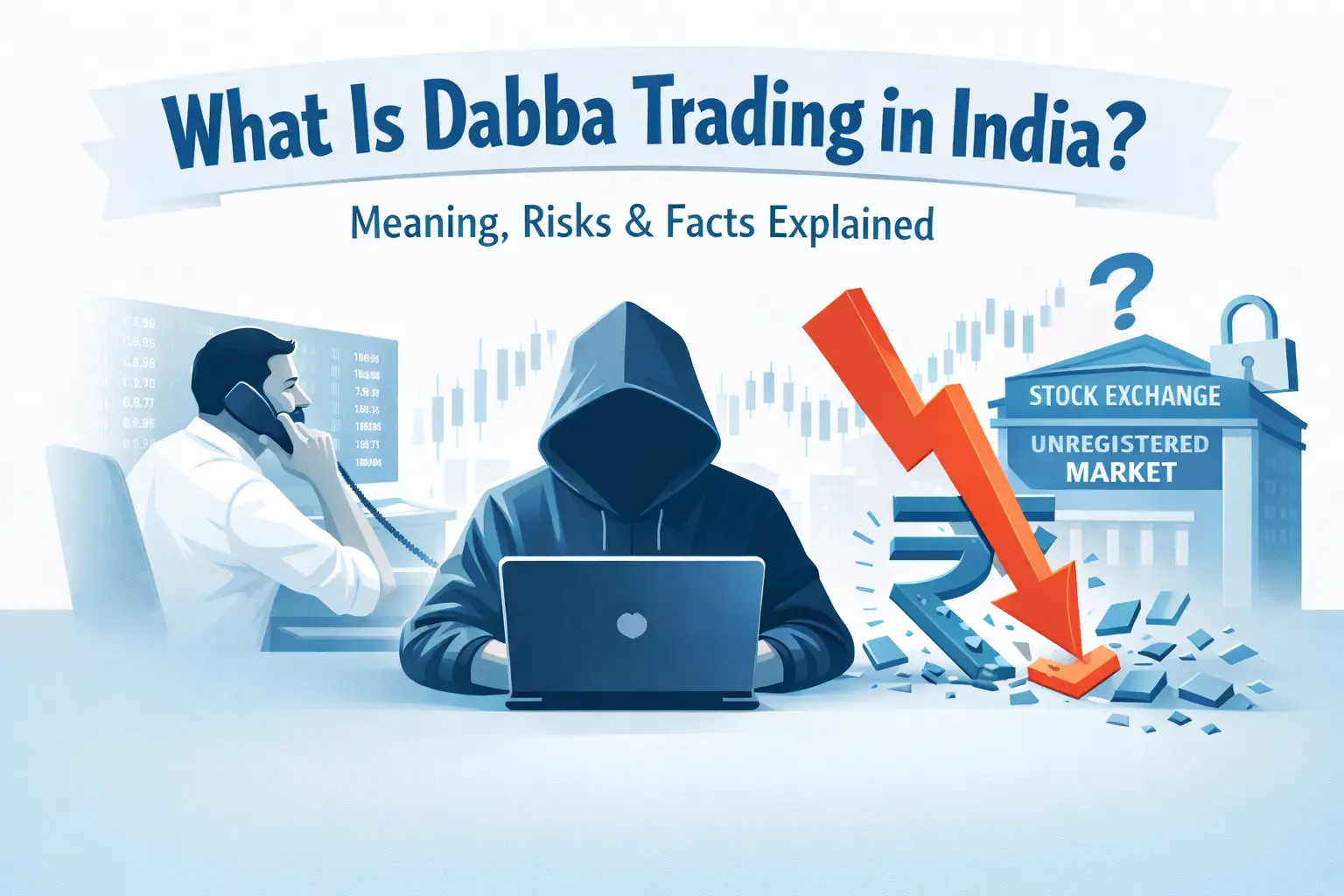
Stock market investing in India has gone mainstream with apps, zero brokerage, instant onboarding, and real-time charts. But alongside legitimate trading, there’s a shadow system that still exists quietly: dabba trading. If you’ve heard this term and wondered what it actually means, how it works, and why regulators keep warning against it, you’re in the right place.
Let’s break it down in simple terms:
Dabba trading is illegal off-market trading where transactions are not recorded on any recognised stock exchange. No NSE. No BSE. No transparency. Just pure risk.
What Is Dabba Trading?
Dabba trading refers to unauthorised trading of stocks, commodities, or derivatives outside official stock exchanges. Instead of placing orders through NSE or BSE, trades happen privately through unregistered brokers or operators — often called “dabba operators.” The word dabba literally means “box,” implying trades happen inside a closed system, invisible to regulators, exchanges, and tax authorities.
In dabba trading:
- Trades are settled privately
- No exchange records exist
- No contract notes are issued
- No investor protection applies
How Does Dabba Trading Work?
A dabba operator:
- Accepts money from traders
- Promises market-linked trading
- Shows live market prices
- Executes trades internally without routing them to exchanges
Instead of placing orders on NSE/BSE, the operator:
- Matches trades internally
- Or simply bets against the client’s position
- Settles profits or losses privately
Typical process:
- The trader deposits money with the operator
- Trades are placed through unofficial terminals or WhatsApp/phone calls
- Prices mirror real market prices
- Profits/losses are calculated internally
- No regulatory reporting or taxation
No exchange. No clearing corporation. No legal backing. It’s financial shadowboxing with real money.
Why Do People Fall for Dabba Trading?
Let’s not pretend dabba trading exists because it offers short-term incentives that look attractive, especially to uninformed or desperate traders.
Common reasons people get pulled in:
- No brokerage or ultra-low charges
- Higher leverage than legal brokers
- No KYC hassles
- Instant account opening
- Ability to trade large volumes with small capital
- Evasion of taxes
Sounds convenient, right? But convenience without compliance = chaos. If a trading setup feels too easy, too flexible, and too off-the-books, it’s probably illegal.
Why Is Dabba Trading Illegal in India?
Dabba trading violates multiple Indian laws and regulatory frameworks, including:
- SEBI Act, 1992
- Securities Contracts (Regulation) Act, 1956
- Prevention of Money Laundering Act (PMLA)
India’s stock market ecosystem exists to ensure:
- Price transparency
- Fair execution
- Investor protection
- Market integrity
Dabba trading destroys all four.
Why regulators crack down hard:
- No investor grievance redressal
- No trade settlement guarantee
- No tax reporting
- High risk of fraud and manipulation
- Enables money laundering and black money circulation
SEBI regularly conducts raids, arrests operators, and shuts down illegal trading networks. Traders involved can also face legal consequences, not just the operators. Dabba trading isn’t a loophole. It’s a criminal offence.
Risks of Dabba Trading (And Why It’s a Terrible Idea)
Dabba trading is financial Russian roulette.
Major risks include:
- Total Loss of Capital
Operators can disappear overnight with zero accountability. - No Legal Protection
Since trades are illegal, you can’t complain to SEBI, exchanges, or courts - Price Manipulation
Operators can alter execution prices or reject profitable trades. - No Trade Records
No contract notes = no proof. - Tax & Legal Trouble
Participation itself can invite scrutiny. - Counterparty Risk
The operator is your broker, exchange, and settlement body — all in one. That’s insane risk concentration.
Corporate translation: You’re trusting your money to vibes and verbal promises. Bad business model.
Dabba Trading vs Legal Stock Trading
Let’s compare.
| Feature | Dabba Trading | Legal Trading |
| Exchange execution | ❌ No | ✅ NSE/BSE |
| Regulatory oversight | ❌ None | ✅ SEBI |
| Investor protection | ❌ None | ✅ Yes |
| Contract notes | ❌ No | ✅ Yes |
| Settlement guarantee | ❌ No | ✅ Yes |
| Legal risk | 🚨 High | ✅ Safe |
There’s no debate here. Legal trading wins on every axis: safety, transparency, sustainability, and trust.
How to Identify Dabba Trading Operations
If someone offers you trading that includes any of the below, walk away immediately:
- No KYC or documentation
- Trades via WhatsApp, Excel sheets, or phone calls
- Guaranteed profits or fixed returns
- No official trading app or exchange login
- Cash-only deposits
- No contract notes
- No SEBI registration number
If it’s not routed through NSE or BSE, it’s not real trading.
Real-Life Impact of Dabba Trading
Dabba trading doesn’t just hurt individual traders; it damages the entire financial ecosystem.
System-level consequences:
- Distorts price discovery
- Reduces tax revenue
- Encourages financial fraud
- Undermines investor confidence
- Fuels black money circulation
At the individual level:
- Traders lose savings
- Families face financial distress
- Legal complications arise
- No recourse exists
This isn’t hustle culture. It’s financial exploitation disguised as opportunity.
Legal and Safe Alternatives to Dabba Trading
Here’s the good news: Today, India offers legitimate, low-cost, regulated trading platforms that eliminate the reasons people used to dabba trade.
Safer alternatives:
- Zero brokerage stock trading apps
- SEBI-registered brokers
- Online demat accounts
- Regulated derivative platforms
- Transparent margin policies
Modern brokers offer:
- Instant onboarding
- Mobile trading
- Tight spreads
- Low brokerage
- Investor protection
You no longer need illegal shortcuts to trade efficiently.
Is Dabba Trading Still Common in India?
Yes — but shrinking fast. With:
- Increased SEBI surveillance
- Digital trade audits
- Real-time monitoring
- Crackdowns and arrests
- Financial literacy awareness
Dabba trading is becoming riskier and harder to operate, which is good news for market integrity. But in certain cities and informal networks, it still exists, which is why awareness matters.
Final Thoughts
Let’s call it what it is.
Dabba trading in India is illegal, unsafe, and financially reckless.
It offers zero investor protection, zero transparency, and infinite downside.
While it may look tempting because of:
- Low costs
- High leverage
- Easy onboarding
The reality is:
- One dispute = total loss
- One operator exit = vanished capital
- One investigation = legal trouble
In today’s fintech-driven India, there is no justification for trading outside regulated platforms. Smart money doesn’t cut corners. It compounds responsibly.