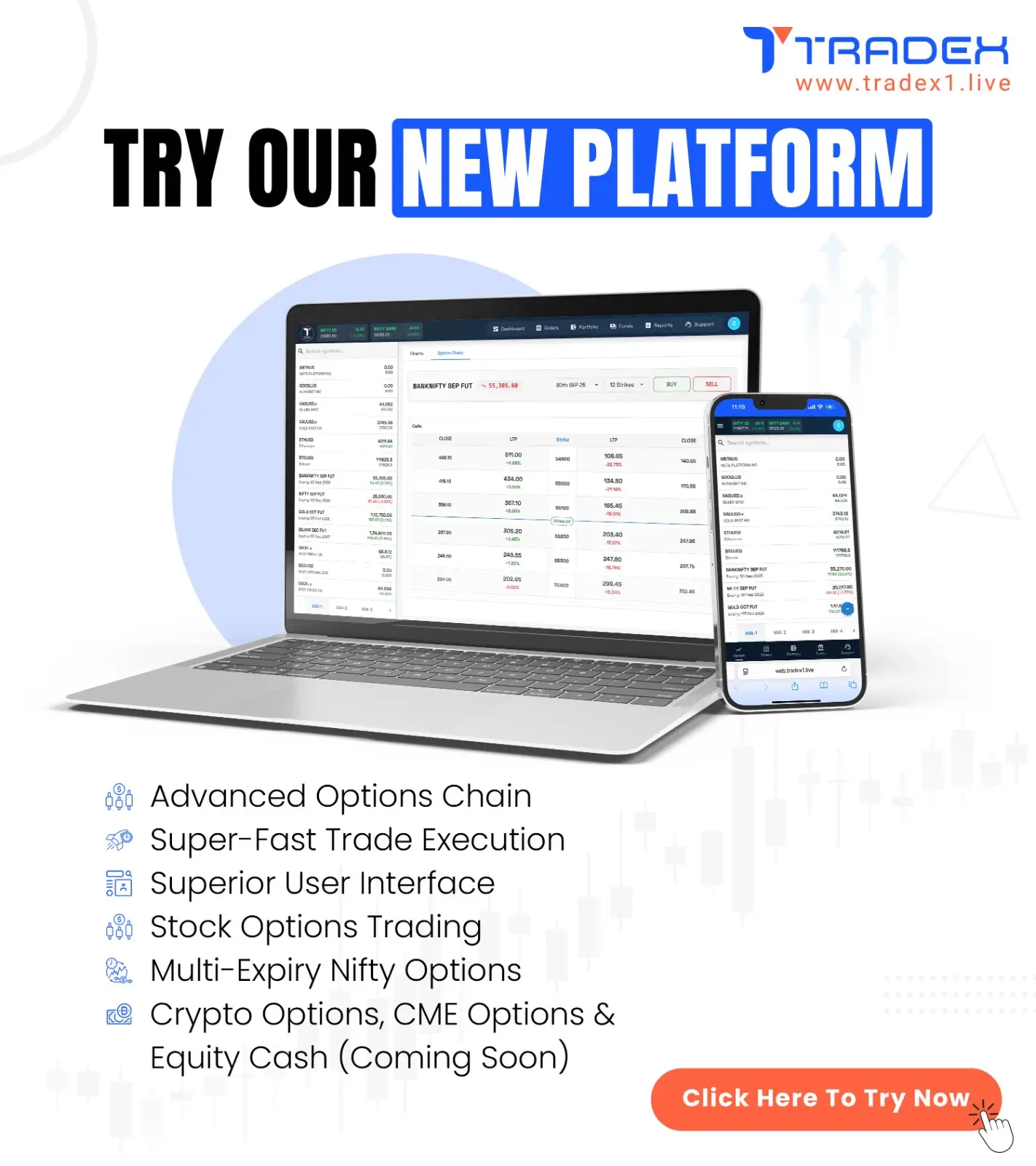
“What you earn is what you keep.”
Zero brokerage feels like that. Sounds good, right?
But here’s the kicker—not all that glitters is gold. Many traders get hit by zero brokerage hidden charges, which include withdrawal charges or inactivity fees, account management charges and STT & transaction cost.
But don’t let the small fees or charges eat your big profits.
But with Tradex1.live it’s quite simple.
- Instant withdrawals
- No hidden fees
- True zero brokerage
That’s why Tradex1.live shines and leaves the rest.
But before hopping on, start trading.
Let’s look at this Tradex1.live guide, which curates the fundamentals of trading charges breakdown India so that no one can trick you and you can trade freely.
Let’s hop on!
What actually are brokerage fees India explained
Definition
A brokerage fee is a kind of charge that a broker can collect from traders when they place or execute any order, whether buying or selling a stock or any other financial instrument. To put it another way, it is the cost that is meant to utilize the broker’s platform and the services for trade execution.
Key points
- Brokerage is kind of a trading cost and not considered a tax.
- Its typical window is 0.01% to 0.5% of the trade value.
- Some brokers also ask for the charges, which are often flat per trade and are Rs.10 to Rs.100.
- Other costs are also incorporated, such as account opening fees, exchange fees, and more.
- Fees also vary, which depends upon the type of trade you are trading, such as equity, commodity, or derivative.
Example
- Let’s see you buy a share worth Rs.10000.
- Broker charges are 0.1%, then brokerage charges are Rs.10.
- Along with that, the broker also applies the minor charges like DP charges that may apply, which can also add extra perks.
- So, the typical cost range is Rs.10-Rs.100.
Zero Brokerage Hidden Charges That You Must Know
Small trading fees can quietly add up even with the small brokerage, and here’s what you should be aware of
| Charge | Details |
| STT/CTT | Paid to the government |
| Exchange fees | Sent to BSE/NSE |
| GST | 18% on service and transaction |
| SEBI Charges | Small percentage to the regulator |
| Call and trade | Additional Rs.20-Rs.50 per call order |
| Auto square off | A fine of Rs.50 if the intra-position is open past 3:15 PM. |
| Pledge charges | Applied if pledging shares on margin |
7 Zero Brokerage Hidden Charges That You Must Watch For
Here is a list of hidden costs or charges that you should be aware of, including:
1.Account opening charges
Some brokers might ask for free charges for the setting up of a demat account. Even if they claim trading is free.
2. Annual maintenance charges (AMC)
A recurring fee is usually required so that your demat account needs can be maintained. Some brokers offer it for a limited time, such as free AMC for the very first year.
3. DP charges
Depository participant charges also may be applicable, which are levied by the CDSL/NSDL. This is applicable when you sell your shares each time. Often it is fixed, but it is as per the broker.
4. Transaction charges
Brokerage charges might be zero, but exchanges such as NSE or BSE might require small fees. Even SEBI charges are also applicable. They might seem very small, but when they add up, they can lead to a significant amount, specifically if you trade very often.
5. Payment gateway charges
Adding or withdrawing funds? In the scenario some brokers may ask for a small fee.
6. Call and trade charges
Placing an order through your phone? Then expect some additional charges in comparison with online trading.
7. Inactivity fees
If your account stays inactive for a long duration, then you might be charged a fee.
Important tip: Always look for the hidden costs trading. And zero brokerage doesn’t mean zero cost.
Don’t want to let the hidden charges bite your profit? With Tradex1.live, you get real zero brokerage charges and transparent trading with instant withdrawals.
No surprises. No tricks.
Brokerage fees India explained: Benefits of the Zero Brokerage Demat Account
A zero brokerage account means that there are no additional costs reducing your profits, allowing you to retain more of your earnings:
Key benefits of a zero-brokerage demat account
Beginner investors
They can enter with zero brokerage into the market with minimum capital, learn the ropes, and eliminate high per-trade fees and understand the hidden costs trading.
Long-term investors
It helps them to lower the cumulative brokerage charges while holding investments for the long term without extra baggage.
SIP investors
Minimizing the cost on regular SIP installments (ELSS, stocks, and mutual funds) can lead to long-term returns.
Small traders
They can protect more profits when they can treat low-value or more frequent trades.
Trading charges breakdown India: How Brokerage fee is Calculated
Brokerage fees are calculated in two different ways, depending upon the trade type account as well as on the broker.
- Percentage-Based
- Flat-fee
| Type | How it works | Typical trade | Who uses it? |
| Percentage-Based | Charges a small percentage of the total trade amount (the more you trade, the higher is the fee). | Delivery/intraday | Suited for full-service brokers
|
| Flat-fee | Fixed cost as per trade regardless of the trade size | Any trade size | Discount brokers |
Why Tradex1.live is best for Zero brokerage trading
Tradex1.live makes zero brokerage, which actually works in your favor, and it comes with no surprises, no hidden costs.
Here’s what makes Tradex1.live set apart
- True zero brokerage—Not a half-truth; you pay zero brokerage on trades. You keep more of what you earn.
- No surprises, no hidden charges— Transparency on every kind of fee such as GST, SEBI charges, STT, etc., so no last-minute surprises.
- Instant withdrawals—Your funds are always yours, so when you need them, you get them—no waiting.
- Straightforward pricing—No fine print, no confusion, and no complicated slabs.
- Simple and fast platform—It is built for real traders, no matter if you are new or experienced.
Still paying hidden fees? Switch to tradex1.live because “every penny you saved is every penny you earned.”
Conclusion: Keep More of Your Profits with Tradex1.live
While zero brokerage may seem appealing, it’s important to approach it with caution.
That’s what’s true in the trading market.
Those small fees? They added up. Slowly. Silently.
That’s where zero brokerage hidden charges come into play. They can be easy to miss but fetch large profits.
Why deal with confusion when you can trade with clarity? With Tradex1.live, there are no hidden charges, zero brokerage, and instant withdrawals.
Are you tired of confusing charges and hidden fees?
Simply start your trade with Tradex1.live and take full control.
FAQs
1.Are exchange fees and taxes the same on all apps?
Yes, statutory charges, which include stamp duty, GST, and SST, are the same.
2. Does zero brokerage really mean no charges?
No, it means that the broker does not ask for a fee, but other responsible charges are applicable.
3. Do I need to pay taxes even if I choose a zero brokerage platform?
Yes, the fixed charges such as SEBI charges, GST, and others are compulsory.
4. What is AMC?
AMC are account maintenance charges, and they can be taken by brokers to maintain the account, but some are provided free for a limited time duration.
5. Will the small fees impact my profit?
Yes, small fees can impact specifically if you go for frequent or small trades.
6. Is a zero-brokerage platform like Tradex1.live good for beginners?
Absolutely, it allows minimizing the initial trading cost.
7. How can I avoid the hidden charges on a platform?
The hidden costs trading can be significantly avoided by looking at the broker’s price in detail as well as viewing the fine print carefully.
You may also be interested to know: