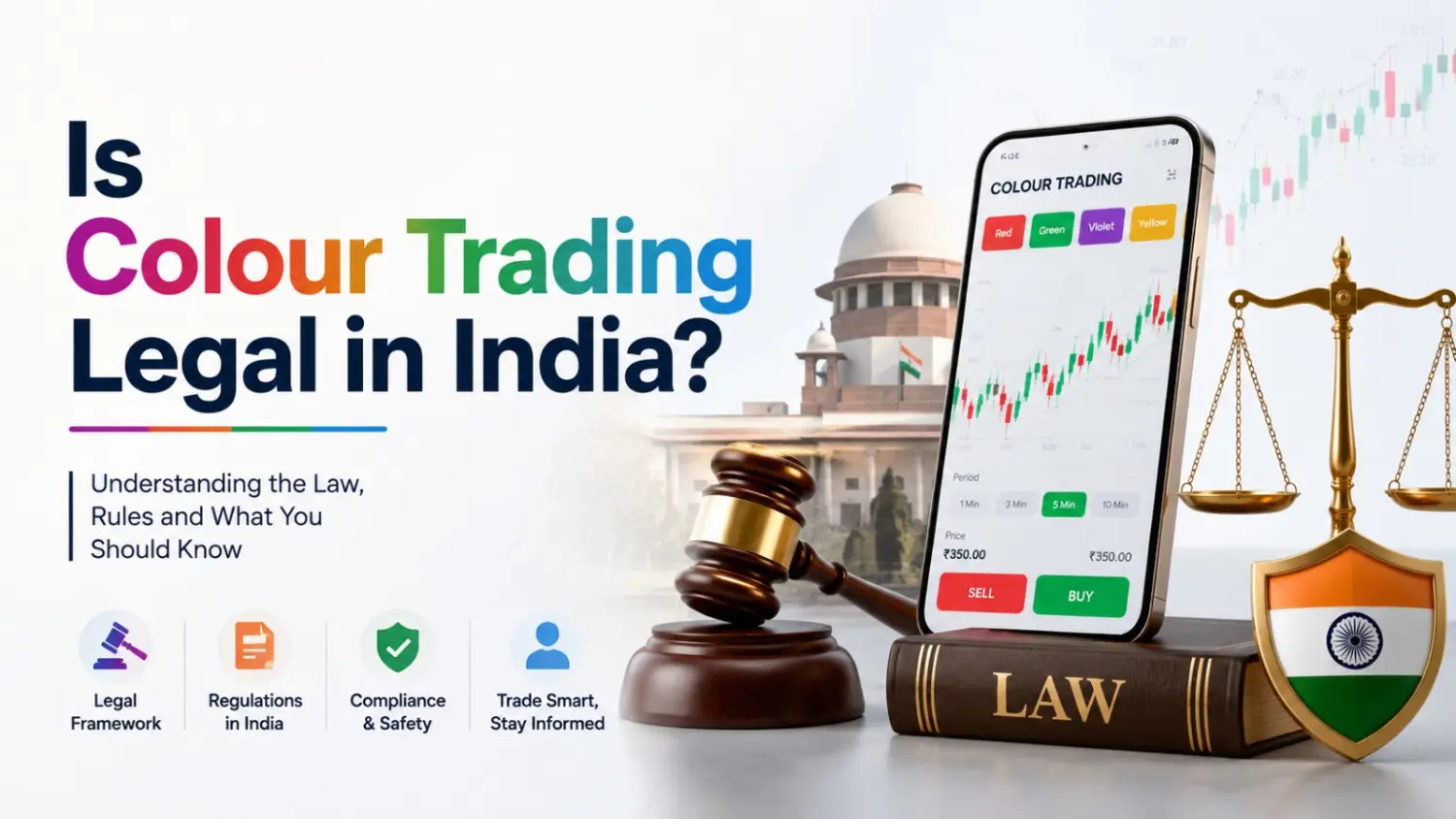
Quick answer: No. Colour trading is not legal in India. Despite the “trading” label, colour trading (also called colour-prediction or colour-betting) is a game of chance in which you stake money on which colour appears next. Under Indian law that is gambling, not investing. It is barred by the Public Gambling Act, 1867, by several state anti-gambling laws, and — most decisively — by the Promotion and Regulation of Online Gaming Act, 2025, whose rules came into force on 1 May 2026. Running, promoting, or processing payments for these games is now a criminal offence in India.
If you are deciding whether to deposit money into a colour-trading app, the short version is: don’t. The rest of this guide explains why, what the law actually says, what happens to players, and what to do if you have already lost money.
What is “colour trading”?
Colour trading is an online betting format dressed up in the language of finance. You are shown a timer and a set of colours — usually red, green and violet — and you put money on which colour (or number) will be drawn when the timer ends. Guess correctly and you are paid a multiple of your stake; guess wrong and you lose it.
The activity is marketed under many names and through many apps and websites (you may have searched for terms like 91 Club colour trading, Tiranga colour trading, Daman, colour prediction game, and similar). The branding changes constantly. The mechanics do not: you are wagering money on a random outcome.
It is promoted aggressively through search ads, social-media influencers, WhatsApp and Telegram groups, and “earning” videos that promise quick, easy income. That marketing is precisely what the 2025 law was written to stop.
Is colour trading “trading”, or is it gambling?
This is the single most important point, because it decides the legal outcome.
Real, regulated trading and investing in India involves an underlying asset (a share, bond, commodity, or fund unit), a recognised exchange or platform, ownership or a contractual claim, and oversight by a regulator such as SEBI (Securities and Exchange Board of India) or the RBI (Reserve Bank of India).
Colour trading has none of those things. There is no asset, no ownership, no exchange, and no regulator. The outcome is random and the “return” comes only from other players’ losses. Indian courts have long drawn a line between a game of skill (where skill predominates) and a game of chance (where it does not). Colour prediction sits firmly on the chance side — which is the legal definition of gambling.
| Regulated investing | Colour trading | |
|---|---|---|
| Underlying asset | Yes (shares, bonds, funds) | None |
| Ownership / claim | Yes | None |
| Recognised exchange/platform | Yes | No |
| Regulator | SEBI / RBI | None |
| Outcome determined by | Market value, fundamentals | Random draw |
| Legal classification | Investment | Gambling (game of chance) |
So when an app calls its product “trading”, it is using a financial-sounding word to make gambling look like a legitimate way to grow money. It is not.
Is colour trading legal in India? The legal position
Several layers of Indian law apply, and they all point the same way.
1. The Public Gambling Act, 1867
India’s oldest gambling statute prohibits running and operating common gaming houses and games of chance for money across most of the country. Colour-prediction games fall within this prohibition because they are chance-based wagering.
2. State anti-gambling and online-gaming laws
Gambling has historically been a state subject, and many states have gone further with their own bans. States such as Telangana, Andhra Pradesh and Tamil Nadu have amended their gaming laws to specifically outlaw real-money online games of chance, leading to frequent police action and the freezing of operators’ — and sometimes participants’ — bank accounts. The few states with limited gaming carve-outs (for example, Sikkim and Nagaland) permit only narrowly defined games of skill or tightly licensed casino activity, which colour prediction does not qualify for.
3. The Promotion and Regulation of Online Gaming Act, 2025 (the decisive law)
This is the law that closed the remaining grey area nationwide. The Bill was passed by both houses of Parliament in August 2025 and received Presidential assent on 22 August 2025. The accompanying Promotion and Regulation of Online Gaming Rules, 2026 were notified on 22 April 2026 and took effect on 1 May 2026.
The Act takes a split approach:
- It promotes e-sports and online social (non-money) games, recognising them as a legitimate sector.
- It imposes a blanket prohibition on all “online money games” — any online game where you pay or stake money in the hope of winning money — regardless of whether the game is one of skill or chance.
Crucially, the prohibition has three prongs. The Act makes it illegal to (a) offer an online money game, (b) advertise or promote one through any medium, and (c) facilitate payments for one, including by banks and financial intermediaries. Because colour trading is a real-money game, it is caught squarely by all three.
The Act also created a national regulator (the new online-gaming authority) and confirmed the government’s power to block illegal sites and apps. Over 1,500 gambling and betting platforms were blocked between 2022 and 2025 under Section 69A of the IT Act, and enforcement against colour-trading operations — including app takedowns, social-media account blocks and frozen payment routes — has continued.
What are the penalties?
Penalties under the 2025 Act fall mainly on the businesses, promoters and enablers behind these games. The offences are treated as serious (cognizable and non-bailable), and company directors can face personal criminal liability.
| Activity | Reported penalty under the Act |
|---|---|
| Offering an online money game | Up to 3 years imprisonment and/or a fine up to ₹1 crore |
| Repeat offence | Up to 5 years and/or ₹2 crore |
| Advertising or promoting such games | Up to 2 years and/or ₹50 lakh |
| Facilitating payments (banks/intermediaries) | Prohibited; subject to penalty |
Figures reflect widely reported provisions of the Act; confirm exact amounts against the official statute and current rules before relying on them.
The advertising penalty is the reason influencers and affiliates promoting colour-trading apps are now exposed to real legal risk, not just the app owners.
“But will I, as a player, get arrested?”
This is the most common question, and the honest answer has nuance.
The 2025 Act’s offences are aimed at service providers, operators, advertisers and payment facilitators — not at individual players who merely use such services. So the central law does not, by itself, criminalise the act of placing a bet on a colour-prediction app.
That is not a green light, for three reasons:
- Some state laws can still penalise players. State gambling statutes vary, and a few can act against participants, including freezing the bank accounts of people who transacted with a flagged operator.
- You have zero legal protection. These platforms are unregistered and unrecognised by SEBI, RBI or any authority. If the operator refuses your withdrawal or vanishes, there is no regulator to appeal to and recovery is extremely difficult.
- You may unknowingly be drawn into money laundering. Investigations have repeatedly tied these apps to laundering networks; routing money through them can entangle ordinary users in a criminal investigation.
So even where playing is not itself the charged offence, the financial and legal downside is severe and the upside is illusory.
The constitutional challenge (for completeness)
The 2025 Act has been challenged before the Supreme Court of India by affected parties, on two main grounds: that the central government may have overstepped, because betting and gambling fall under the State List of the Constitution, and that the ban infringes certain fundamental rights. In September 2025 the Supreme Court consolidated all such cases before itself. As of mid-2026 the matter is pending, but the Act is in force and is being actively enforced. A pending challenge does not make colour trading legal in the meantime.
Why colour-trading apps are dangerous (not just illegal)
Illegality aside, these platforms are built to take your money. Common patterns reported by victims and investigators include:
- Early “wins” to hook you. Small initial payouts build trust, encouraging larger deposits — the classic structure of a scam.
- Blocked withdrawals. Once balances grow, withdrawals are delayed, hit with fake “fees” or “taxes”, or refused outright.
- Sudden shutdowns. Apps and domains disappear overnight and reappear under a new name, taking deposits with them.
- Data and banking theft. Unregulated apps harvest personal and financial details that can be sold or misused.
- Addiction and serious harm. The fast, repetitive betting loop is designed to be compulsive. Authorities have linked it to financial ruin, family distress and even suicides.
Red flags to recognise instantly
- It asks you to deposit money to predict an outcome (colour, number, “up/down”).
- It promises guaranteed, fast or “risk-free” returns.
- It is not listed on official app stores, or spreads through APK files, referral links and WhatsApp/Telegram agents.
- It has no SEBI/RBI registration and no verifiable company details or grievance process.
- It is pushed by influencers, bonus offers and “earning” videos.
If you see these signs, treat the platform as illegal and unsafe.
What to do if you have already lost money
You are not the first, and there are official channels. Acting quickly improves your chances.
- Stop depositing immediately and do not pay any “fee” demanded to release a withdrawal — that is part of the scam.
- Report to the National Cyber Crime Reporting Portal at cybercrime.gov.in, or call the cyber-crime / financial-fraud helpline 1930 as soon as possible. Fast reporting can help freeze the money trail.
- Inform your bank or payment provider to flag and try to halt the transactions.
- Preserve evidence: screenshots, transaction IDs, app/website links, and any chats with agents.
- Consult a lawyer if significant money is involved or your account has been frozen; formal recovery and account restoration go through banking and law-enforcement processes and can take time.
Legitimate alternatives if you want to grow your money
The instinct behind colour trading — wanting your money to grow — is reasonable; the vehicle is not. Regulated, legal options in India include investing through SEBI-registered brokers and stock exchanges, mutual funds and index funds, government schemes and fixed-income products, and seeking guidance from a SEBI-registered investment adviser. These carry genuine market risk and no guaranteed returns, but they involve real assets, regulatory protection and recourse — everything colour trading lacks.
Read More Blogs :
1. Tick Security Trading for Tradex
2. How Much Money You Really Save for Your Retirement Years in India?
Frequently asked questions
Is colour trading legal in India in 2026?
No. It is prohibited under the Public Gambling Act 1867, various state laws, and the Promotion and Regulation of Online Gaming Act, 2025 (rules effective 1 May 2026). It is gambling, not trading.
Is 91 Club / Tiranga / [any colour-prediction app] legal?
No. The brand name does not matter. Any app that asks you to stake money to predict a colour or number is an illegal online money game in India, regardless of what it calls itself.
Is colour trading the same as stock trading?
No. Stock trading involves real, regulated assets on recognised exchanges under SEBI oversight. Colour trading has no asset, no exchange and no regulator — it is chance-based betting.
Can I legally play if I only “predict” and don’t think of it as betting?
No. Staking money on a random outcome is wagering under Indian law, whatever you call it. The platform is still illegal and unsafe.
Will I be arrested for playing colour trading?
The 2025 Act targets operators, promoters and payment facilitators rather than individual players. However, some state laws can act against players, you have no legal protection, and you risk being caught in money-laundering investigations. Playing is strongly inadvisable.
Can I get my money back from a colour-trading app?
There is no guarantee. Report to cybercrime.gov.in or call 1930 immediately, alert your bank, and preserve evidence. Recovery is difficult and not assured.
Is it legal in any Indian state?
No state provides a legal route for real-money colour-prediction games. States with limited gaming carve-outs allow only specific games of skill or licensed casino activity, which this is not.
Why do so many ads say colour trading is legal and profitable?
Because the people running and promoting these platforms profit from your deposits. Such advertising is itself now an offence under the 2025 Act.
Sources and further reading (recommended outbound citations)
- Promotion and Regulation of Online Gaming Act, 2025, and the Online Gaming Rules, 2026 (official text via India Code / MeitY)
- The Public Gambling Act, 1867
- Securities and Exchange Board of India (SEBI) — investor education
- Reserve Bank of India (RBI) — public awareness on unauthorised platforms
- National Cyber Crime Reporting Portal — cybercrime.gov.in (helpline 1930)[ Log In Our Website ]